
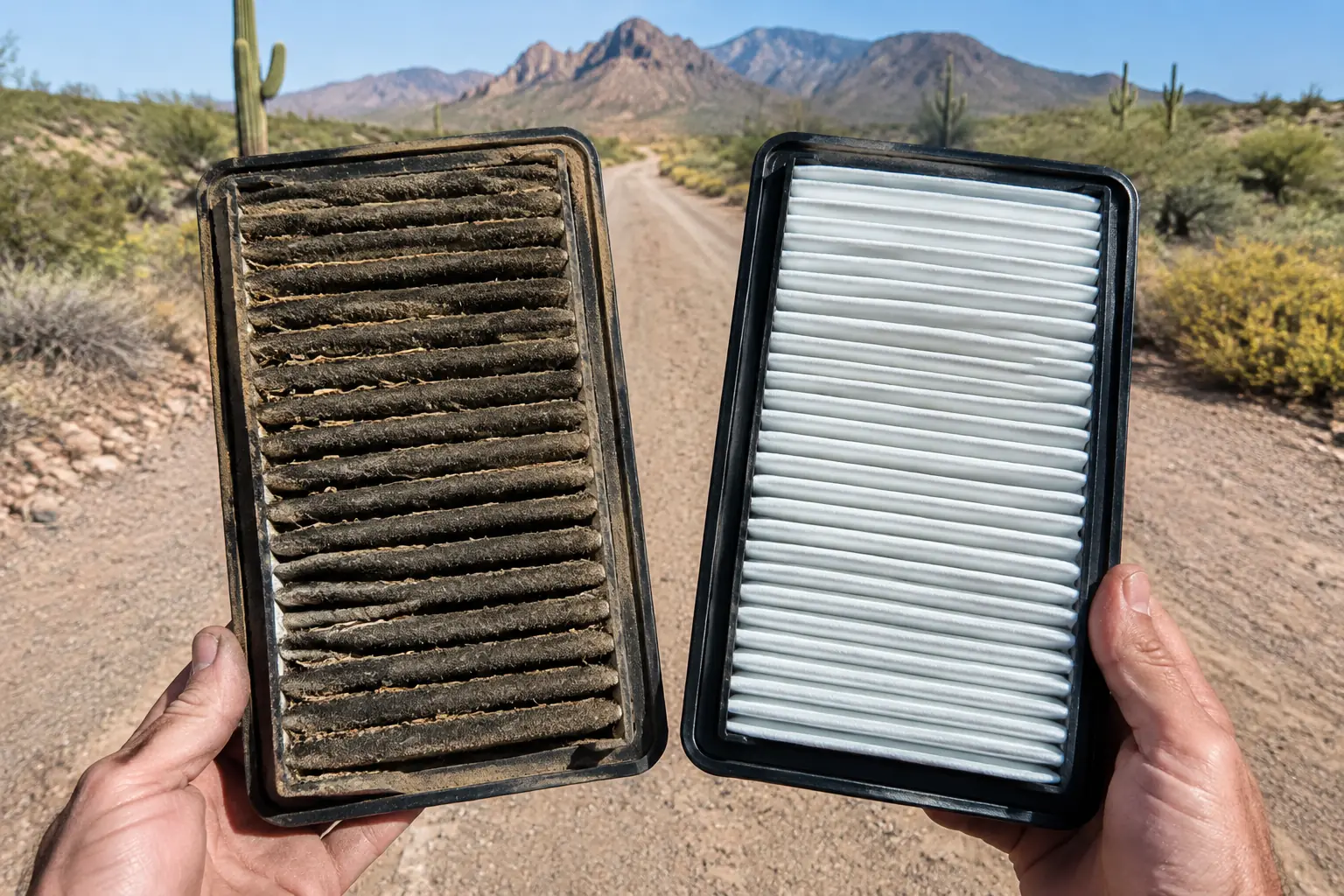
Maintenance & oil · Guide
When Tucson Dust Means Your Air Filters Need Changing
9 min readBy The Mando Guild mechanics
Air filter replacement in Tucson is due when dust loading, damage, or your vehicle's maintenance schedule calls for a new filter. The Mando Guild checks your engine and cabin filters where you park, explains what needs attention, and provides a written estimate before you approve any replacement.
Two filters protect different parts of your drive
Your engine air filter catches airborne debris before intake air reaches the engine. Your cabin air filter, if your vehicle has one, filters air moving through the heating and air-conditioning system. They serve different purposes, live in different housings, and do not necessarily need replacement together. Treating them as separate maintenance items helps you avoid paying for an unnecessary matched pair.[1]
The engine filter is usually inside an air cleaner housing under the hood. The cabin filter may sit behind the glove compartment, under the dashboard, or near the windshield cowl. Access varies enough that a quick job on one vehicle can involve removing several trim pieces on another. The vehicle's service information should guide access, filter selection, and installation.[2]
When you ask about engine air filter replacement in Tucson, tell us if your concern is engine performance, dusty vents, or weak cabin airflow. That distinction helps direct the inspection. A cabin filter will not protect the engine, and a fresh engine filter will not remove pollen from the air blowing toward your face.
How often should Tucson drivers check and replace filters?
Start with your owner's manual rather than a universal mileage promise. Manufacturers specify inspection or replacement intervals, and dusty operating conditions can call for more frequent attention. Your engine and cabin filters may have separate schedules. Follow the applicable mileage or time limit, including any instructions specifically addressing dirt roads or heavy dust exposure.[1]
As a practical planning habit, ask for a filter check when your vehicle receives scheduled maintenance. Check sooner after repeated dusty trips or if airflow changes. This is an inspection recommendation, not a rule that both filters need replacement at every oil change. A filter with substantial service life remaining should not be discarded simply because the housing is already open.
For a vehicle used mostly on paved streets, the manufacturer's schedule remains the starting point. For one regularly traveling unpaved access roads, condition checks deserve more attention between scheduled replacements. Our guide to severe-service schedules in Tucson explains how to identify the relevant maintenance instructions without assuming that every desert vehicle needs the same shortened interval. Keep the last replacement date and mileage so the next decision has context.
Why Tucson dust exposure matters more than your ZIP code
A Tucson address alone does not tell us how quickly a filter will load up. Your actual route matters. Construction areas can expose vehicles to dust and debris, making maintenance checks worth closer attention.[3] Daily travel near disturbed soil, gravel parking areas, or dry wash approaches gives us a different inspection picture than occasional errands on paved roads.
Consider the entire trip rather than just the main road. You might spend most of your commute on Oracle Road but finish on an unpaved driveway. A work vehicle may make short trips yet repeatedly enter dusty sites. Tell your mechanic about those conditions, even if your mileage seems low. Distance does not capture every kind of exposure.
This does not mean replacing filters after every dusty afternoon. It means inspecting with your driving conditions in mind and comparing what we find with the maintenance schedule. A lightly dusty surface and densely packed pleats are different findings. We also want to know whether dust is staying on the dirty side of the filter or appearing where filtered air should be.
What an engine filter inspection should actually establish
A useful inspection goes beyond noticing that the filter is no longer white. We look at accumulated debris, the condition of the pleats, the sealing edge, and how the element fits its housing. Tears, distortion, or a poor seal deserve attention because filtration depends on air passing through the media rather than around it. Filter condition and correct installation matter together.[1]
Color alone is not a reliable replacement schedule. Filter materials differ, and surface discoloration does not describe the entire element. The decision should consider the manufacturer's requirements, visible loading, damage, and service history. If your vehicle uses a restriction indicator, its interpretation should follow the manufacturer's instructions rather than a generic visual rule.
We also check that the housing closes properly and that accessible intake connections are secure. Installing a new element without addressing a displaced seal or an improperly fastened cover leaves the job incomplete. If something beyond routine filter replacement needs attention, that becomes part of the explanation and written estimate. You can then approve the appropriate work rather than guessing from a photograph of a dirty filter.
Performance symptoms do not automatically mean a clogged filter
A heavily restricted engine air filter can affect performance, but sluggish acceleration is not proof that the filter caused it. Fuel delivery, ignition, intake leaks, and other faults can produce similar complaints. Describe when the problem happens, such as during acceleration or only after startup, instead of requesting a filter as a guaranteed cure.
Be cautious about promises of dramatic fuel savings. FuelEconomy.gov explains that replacing a clogged air filter on a modern fuel-injected gasoline vehicle can improve performance without improving fuel economy. Older carbureted engines behave differently.[4] A needed replacement is worthwhile for the right reasons, but it should not come with an unsupported promise about how much less gas you will buy.
A warning light also calls for diagnosis, not automatic filter replacement. We can inspect the filter while investigating the complaint, but finding dust does not establish the cause of a stored fault. If a light is part of your concern, our Tucson check engine light guide explains the next steps. Keep the filter discussion focused on its condition and the evidence available.
Cabin filters, Tucson allergies, and weak vent airflow
A cabin filter can trap dust, pollen, and other airborne particles before they circulate through the ventilation system. As it becomes loaded, it can restrict airflow.[1] If the fan sounds normal but less air reaches you at familiar settings, the filter belongs on the inspection list. It is not the only possible cause, so a new filter should not be sold as a guaranteed air-conditioning repair.
For allergy-sensitive passengers, filter selection deserves a little discussion. Different products have different filtration characteristics, and the correct fit still comes first. Ask what the proposed filter is designed to capture and whether it meets the vehicle's requirements. Cabin filtration can reduce some particle exposure, but it is not medical treatment and cannot make a vehicle completely allergen-free.
A musty odor may involve a dirty filter, accumulated debris, or another part of the ventilation system. Persistent smells need investigation instead of repeated filter purchases. Likewise, a filter advertised for odor reduction does not make exhaust fumes safe. Tell us about odors, weak airflow, and allergy concerns separately so we can distinguish a routine maintenance need from a problem requiring further diagnosis.
A monsoon-season filter plan for greater Tucson
Tucson's official monsoon season runs from June 15 through September 30.[5] That makes the weeks before summer storms a useful calendar reminder to review filter history. You do not need to replace a serviceable filter just because June arrives, but knowing its starting condition makes later changes easier to evaluate.
After repeated dust exposure, notice whether cabin airflow has changed and mention the exposure at your next maintenance visit. Construction along your regular route, a gravel parking assignment, or frequent unpaved trips may justify checking sooner than you originally planned. Record the conditions as well as the mileage. That creates a more useful pattern than replacing filters every year on an arbitrary date.
During an active dust storm, visibility and safe driving take priority over maintenance. Dust storms can rapidly reduce visibility, so do not stop in an exposed location to inspect an air cleaner.[6] Our guide to dust storm driving around Tucson covers that separate safety issue. Once the vehicle is safely parked and conditions have cleared, filter concerns can be handled as maintenance rather than a roadside rush.
Why cleaning a disposable filter is not a reliable reset
A disposable filter and a serviceable reusable filter require different care. Follow the filter and vehicle manufacturers' instructions rather than assuming every element can be washed, vacuumed, or blown clean. Maintenance guidance should determine whether cleaning is permitted and when replacement is required.[2] Removing visible loose dust does not establish that an element has regained its original condition.
For ordinary disposable elements, do not improvise with water, solvents, or compressed air unless the manufacturer specifically permits that method. You can damage the media or sealing surfaces while making the filter look cleaner. A reusable aftermarket element may have its own cleaning and preparation procedure, which should not be transferred to a different filter type.
Correct sizing matters just as much as the choice between replacement and cleaning. A nearly matching element can leave gaps or prevent the cover from seating. Before buying a filter yourself, confirm the vehicle's year, model, engine, and applicable part information. If the housing resists closing, stop and check fitment rather than forcing the clips. A secure, correctly seated filter is the goal.
What The Mando Guild does during an on-site filter visit
The Mando Guild brings a stocked service van to your home, workplace, or suitable roadside location in greater Tucson. We do not have a walk-in shop. Every job starts with a diagnosis and a written estimate, and nothing is replaced until you approve it. For filter concerns, that begins with your symptoms, maintenance history, and the relevant vehicle information.
We inspect the accessible filter elements, housings, and seals, then explain what supports replacement or continued use. If you approve replacement, we use OEM-grade parts, verify fit and orientation, and secure the housing. For a cabin filter complaint, we can check airflow afterward while recognizing that unresolved symptoms may require further diagnosis. Engine and cabin findings remain separate recommendations.
Straightforward filter replacements can take only minutes once access is available, but that is not a promised appointment length. Some vehicles require more disassembly, and damaged housings or unrelated symptoms change the work involved. Ask about combining the inspection with mobile oil changes and maintenance so related maintenance can be considered during one visit. We service most makes and models and confirm the details before planning the work.
Build a simple filter record for your Tucson vehicle
Keep separate entries for the engine and cabin filters. Record the inspection date, mileage, whether replacement was performed, and any access or fitment issue. Save the part information when available. At the next visit, those details help distinguish a filter nearing its scheduled interval from one that was recently replaced but has developed an unusual problem.
You do not need an elaborate tracking system. A note on your phone or a maintenance folder works if it stays with the vehicle's records. Include changes in use, such as a new construction-site assignment or regular gravel-road travel. Our Tucson mobile maintenance guide puts filter checks alongside the other routine items without treating every visit as a reason to replace everything.
When requesting service, share your vehicle details, location, symptoms, and the last known replacement date. Say if you want both filters inspected or have a specific airflow concern. The Mando Guild serves greater Tucson, including Flowing Wells, Oro Valley, and Marana. Call (520) 704-0441 or request service Monday through Friday, 8 a.m. to 5 p.m. We are closed Saturday and Sunday.
Sources
- Car Care Council, "Car Care Guide." www.carcare.org/car-care-guide/ (opens in a new tab)
- Consumer Reports, "Your Car Maintenance Checklist." www.consumerreports.org/cars/car-repair-maintenance/your-car-maintenance-checklist-a6808357212/ (opens in a new tab)
- Car Care Council, "Cone Zone Season Can Be Tough on Vehicles." www.carcare.org/2020/07/cone-zone-season-can-be-tough-on-vehicles/ (opens in a new tab)
- U.S. Department of Energy, FuelEconomy.gov, "Keeping Your Vehicle in Shape." www.fueleconomy.gov/feg/maintain.jsp (opens in a new tab)
- National Weather Service, Tucson, "NWS Tucson Forecast Office." www.weather.gov/twc/ (opens in a new tab)
- National Weather Service, "Dust Storm Safety." www.weather.gov/safety/wind-dust-storm (opens in a new tab)
FAQ
Quick answers
Keep reading
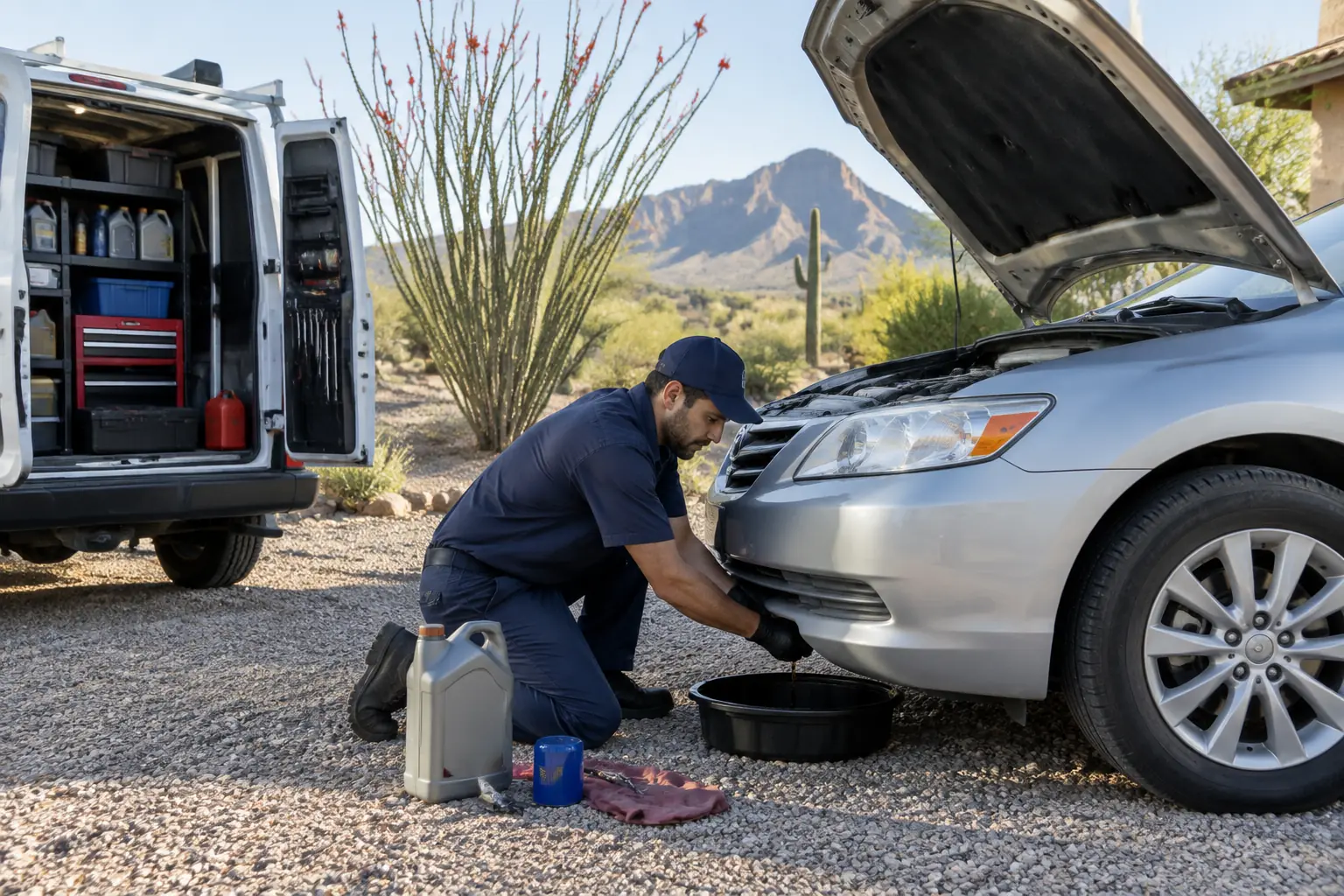 Pillar guideThe Tucson Driver's Guide to Mobile Oil Changes and MaintenancePlan mobile oil changes and seasonal maintenance around Tucson's heat, dust, and monsoon weather without a trip to a shop.Read more: The Tucson Driver's Guide to Mobile Oil Changes and Maintenance →
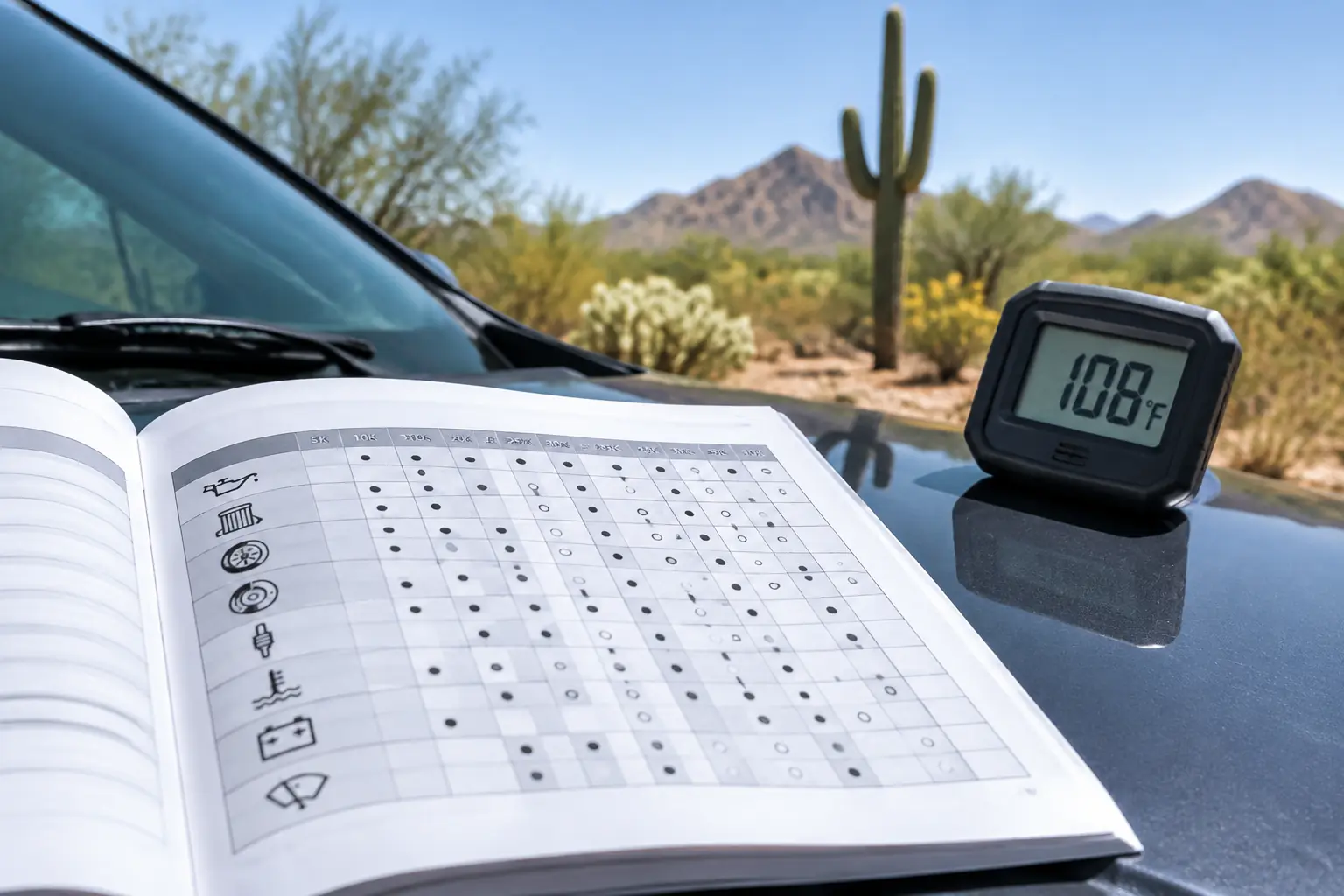 9 min readDoes Tucson Heat Put Your Car on the Severe Service Schedule?Learn how Tucson heat, dust, and short trips affect your car's maintenance schedule and where to find the right intervals.Read more: Does Tucson Heat Put Your Car on the Severe Service Schedule? →
 9 min readChoosing the Right Engine Oil for Tucson Summer HeatLearn how oil chemistry, viscosity, and your engine's specifications guide the right oil choice for Tucson summer driving.Read more: Choosing the Right Engine Oil for Tucson Summer Heat →