
Batteries & starting · Pillar guide
Car Battery Dying in Tucson Heat? Your Complete Guide
9 min readBy The Mando Guild mechanics
A car battery dying in heat is a common Tucson problem because high temperatures accelerate internal damage and fluid loss. The Mando Guild helps Tucson car owners find the actual cause with mobile battery, starting, and charging system diagnosis, followed by a written estimate before any approved replacement.
Why Tucson heat wears out your battery
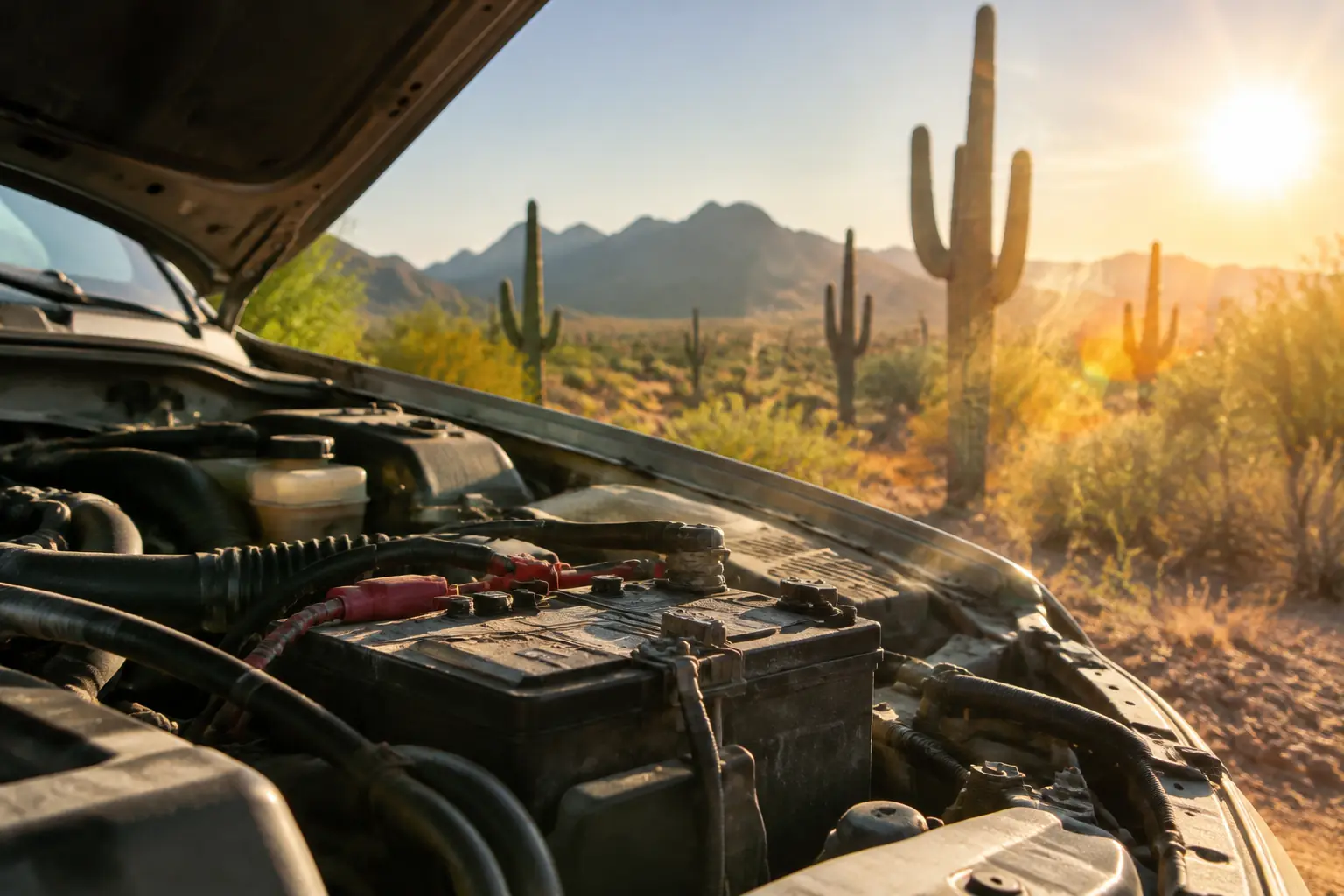
Your starting battery stores chemical energy and releases electrical power to crank the engine. Heat speeds up the chemical activity inside a lead-acid battery, but it also accelerates deterioration. High temperatures promote internal corrosion and the loss of water from the electrolyte. That damage reduces the battery's ability to hold and deliver a useful charge.[1] A battery can still start your car while its remaining capacity is shrinking.
Cold weather gets much of the blame because it makes an already weakened battery struggle to crank an engine. Summer heat may have caused the underlying damage months earlier.[2] In Tucson, where summer highs regularly exceed 100 degrees Fahrenheit, battery condition deserves attention before the first sluggish start.[3] The temperature outside is only part of the picture; engine heat adds another burden to batteries mounted under the hood.
Recharging can restore charge to a serviceable battery, but it cannot reverse worn-out internal components. That distinction explains why a jump start sometimes solves the immediate inconvenience without solving the failure. Your next step should be testing, not assuming that a running engine means everything is healthy.
How long should a battery last in southern Arizona?
There is no dependable replacement birthday for every Tucson battery. Climate, battery construction, charging performance, driving habits, and installation location all influence service life. Hot climates generally shorten battery life compared with cooler conditions.[4] Treat a national lifespan estimate as background information, not a promise that your battery will last that long beside Oracle Road or in a Midtown parking lot.
Start by finding the installation receipt or battery date label. A date code may describe manufacturing rather than installation, so ask for help interpreting it if the meaning is unclear. Age provides context for a test result, especially when you do not know the battery's maintenance history. It does not establish, by itself, that replacement is necessary.
Once your battery has been through several desert summers, make condition testing a deliberate part of maintenance rather than waiting for failure. Consumer Reports recommends annual testing after the battery reaches 2 years old in warmer climates.[4] Test sooner if cranking changes, the battery repeatedly needs charging, or you are preparing for travel. A passing test describes current condition, not guaranteed future life.
Early warnings deserve a test, not a guess
A slower-than-usual crank, repeated jump starts, or electrical accessories that behave differently during startup can point toward a weak battery. Loose connections, excessive circuit resistance, and starting-system faults can produce overlapping symptoms.[5] Notice what happens before and during the failed start. The difference between slow cranking, clicking, and normal cranking helps determine which checks come first.
Pay attention to physical condition, too. A swollen case, leaking electrolyte, or an unusual sulfur-like odor calls for stopping and getting professional guidance rather than trying another jump. Heat and charging problems can damage the battery, and battery gases present an ignition hazard.[2] Do not lean over a suspect battery, create sparks nearby, or attempt to open a sealed case.
For a vehicle that already will not start, use our Tucson no-start guide for the immediate decision process. This guide focuses on understanding and preventing heat-related battery trouble. Replacing a battery solely because the car clicks can leave you with the same problem and an unnecessary part. The symptom is a starting point for diagnosis, not the diagnosis itself.
What a useful battery test actually tells you
A meaningful battery check combines inspection with electrical testing. The case, hold-down, terminals, and cables need attention before interpreting the readings. Corrosion or a loose connection can interrupt current flow even when the battery itself remains usable.[5] A technician also needs to identify the battery type and its rating so the tester evaluates the correct application.
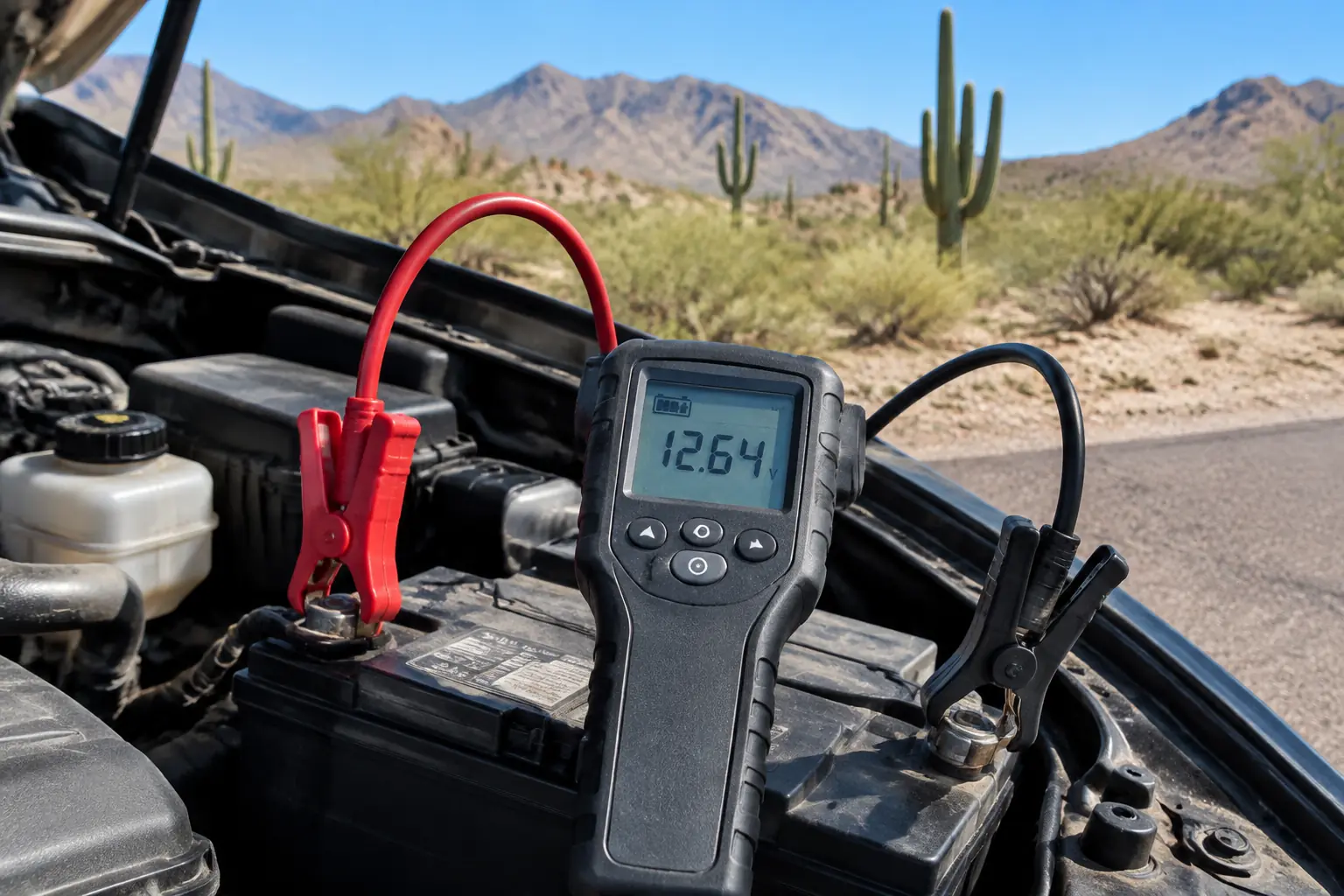
Resting voltage helps describe state of charge, but voltage alone does not establish starting capacity. A battery may show plausible voltage and still fail under demand. Load or conductance testing provides more information about its ability to deliver power.[4] Temperature, recent charging, and the battery's charge level affect interpretation. A deeply discharged battery may need appropriate charging and another test before a replacement decision.
The useful question is not simply, "Did it pass?" Ask what the result means alongside your symptoms and battery age. Testing may point toward replacement, charging and retesting, connection repair, or additional diagnosis. If the battery repeatedly goes flat while parked, checking for an unwanted electrical draw may matter more than buying another battery. Recording the findings gives you a baseline for the next maintenance visit.
Where starters and alternators fit into the diagnosis
In a conventional gasoline vehicle, the battery supplies starting power, the starter turns the engine, and the alternator supplies electrical power and replenishes the battery while the engine runs. A fault in any part of that system can look like battery trouble from the driver's seat. Charging-system problems can also leave a sound battery discharged or damage it through improper charging.[1]
Rapid clicking often accompanies inadequate power reaching the starter, but it does not identify the failed component. A single click is not proof of a bad starter either. Battery condition, cable voltage drop, control signals, and starter operation need to be considered together. Our guide to clicking and starter problems explains those distinctions without turning every noise into a replacement recommendation.
A charging warning light while driving deserves prompt attention. Do not assume it means only that the battery is getting old. See our overview of alternator failure signs for that problem. Never disconnect a battery cable with the engine running as a home alternator test. Proper testing uses equipment and vehicle-specific procedures rather than risking electrical damage to see whether the engine stops.
Choosing a replacement that fits the vehicle
The correct replacement must match more than the space in the battery tray. Case size, terminal location, hold-down fit, electrical capacity, and battery technology all matter. Follow the vehicle manufacturer's requirements rather than choosing by appearance or the largest advertised starting rating.[4] A battery that fits physically can still be wrong for the vehicle's charging strategy.
Vehicles equipped with automatic stop-start systems may require an absorbed glass mat battery or another specified design. Do not substitute a conventional flooded battery where the manufacturer requires a different technology. Some vehicles also require battery registration or a monitoring-system reset after replacement.[5] Those requirements should be identified before installation, not discovered after warning lights or charging behavior change.
Hybrids and electric vehicles need a separate distinction: their low-voltage battery is not the high-voltage traction battery. Electric vehicles have different maintenance and electrical safety requirements from conventional vehicles.[6] A low-voltage problem does not automatically mean the traction battery has failed. Battery identification and model-specific procedures still come first. For the general installation process, read what happens during mobile battery replacement rather than treating every vehicle as an identical swap.
Habits that reduce avoidable battery stress
You cannot remove Tucson's summer heat, but you can reduce avoidable stress. Keep the battery properly secured, address corrosion, and preserve factory heat shields or insulating covers. Excessive heat and vibration both work against battery life.[5] If a cover was removed during previous work, check whether it belongs on your vehicle before assuming it was unnecessary packaging.
Short trips may not restore all the energy used during starting, especially when electrical demand is high. Long periods of storage can also leave a battery discharged.[5] If you rarely drive, ask about a compatible battery maintainer and follow the vehicle and charger instructions. Simply idling occasionally is not a substitute for a charging plan tailored to the vehicle and its use.
Shade can reduce heat exposure, but parking choices cannot repair internal battery damage. Our guide to parking, shade, and battery life covers that trade-off in more detail. Avoid running accessories for long periods with the engine off, and have recurring discharge investigated. Prevention works through several small decisions, not a cooling accessory or a claim that one battery design is immune to desert temperatures.
A practical battery checkpoint before Tucson's monsoon
Tucson's official monsoon season runs from June 15 through September 30.[3] Use the approaching season as a reminder to review battery condition along with other routine maintenance. The calendar is useful because it creates a predictable checkpoint, not because a battery automatically fails when summer storms arrive. A symptom that starts earlier deserves attention earlier.
Think about the places where a failed start would create the biggest disruption. That might be your workplace near the University of Arizona, a grocery stop along Grant Road, or the beginning of a drive on I-10. Testing before a busy stretch of travel is easier to arrange than diagnosis after the car becomes stranded. Keep the installation date and recent test information somewhere accessible.
If the vehicle stops starting during extreme heat, personal safety comes before repeated attempts under the hood. Tell the service provider your exact location and whether the vehicle is safely accessible. Do not assume mobile service means every roadside position is workable. When the parking spot or shoulder exposes you to traffic, arranging a safer location can be necessary before mechanical work begins.
What The Mando Guild checks at your location
The Mando Guild brings a stocked service van to your home, workplace, or an accessible roadside location. We do not have a walk-in shop. Every job starts with diagnosis and a written estimate, and nothing is replaced until you approve it. Tell us the vehicle's year, make, and model, what happened during the failed start, and whether someone recently jump-started or replaced the battery.
For battery-related complaints, the diagnostic path starts with the symptoms and battery identification, then checks condition, connections, and relevant electrical readings. Depending on the findings, we assess charging performance, starting operation, or the need for further testing. A battery that is simply discharged requires a different explanation from one that has failed internally. We explain that difference before recommending parts.
Our battery, starter, and alternator service covers most makes and models and uses OEM-grade parts. If replacement is approved, the installation must respect the vehicle's fitment and electrical requirements. The old battery belongs in an appropriate recycling stream, not household trash. Lead-acid automotive batteries are designed for recycling through established collection systems.[7] Ask about any vehicle-specific setup needs when reviewing the estimate.
Turn battery trouble into a maintenance decision
The goal is to avoid both preventable breakdowns and unnecessary replacement. Start with the battery's history, pay attention to changing startup behavior, and use testing to distinguish low charge from lost capacity. Keep the written findings with your maintenance records. That makes a later slow start easier to evaluate than a vague memory that the battery was checked sometime last summer.
If testing identifies a connection, starter, or charging problem, address that cause rather than expecting a new battery to compensate for it. If the battery is failing, choose the correct replacement and confirm any required setup. Neither age alone nor one successful jump start provides the whole answer. A clear diagnosis gives you a practical next step instead of another guess.
The Mando Guild serves greater Tucson, including Flowing Wells, Casas Adobes, Catalina Foothills, Oro Valley, Marana, Midtown, Downtown, and South Tucson. Mobile work lets you arrange diagnosis where the vehicle is safely parked. Call (520) 704-0441 or request service Monday through Friday, 8 a.m. to 5 p.m. Roadside help is available only during those business hours; we are closed Saturday and Sunday.
Sources
- Car Care Council, "Summer Heat Takes a Toll on Your Car's Battery." www.carcare.org/2020/07/summer-heat-takes-a-toll-on-your-cars-battery/ (opens in a new tab)
- AAA Mountain West Group, "How to Prevent Heat Damage to Your Car Battery." mwg.aaa.com/via/car/prevent-heat-damage-car-battery (opens in a new tab)
- National Weather Service, Tucson, "NWS Tucson Forecast Office." www.weather.gov/twc/ (opens in a new tab)
- Consumer Reports, "Car Batteries." www.consumerreports.org/cars/car-batteries/ (opens in a new tab)
- AAA, "Car Battery Maintenance: 9 Expert Tips to Extend Battery Life." www.aaa.com/autorepair/articles/car-battery-maintenance-9-expert-tips-to-extend-battery-life (opens in a new tab)
- U.S. Department of Energy, AFDC, "Maintenance and Safety of Electric Vehicles." afdc.energy.gov/vehicles/electric-maintenance (opens in a new tab)
- Battery Council International, "Battery Council International." batterycouncil.org/ (opens in a new tab)
FAQ
Quick answers
Keep reading
 9 min readCar Won't Start in Tucson? What to Do, Step by StepLearn what clicks, cranking, and dashboard lights mean, when a jump is safe, and when to call a Tucson mobile mechanic.Read more: Car Won't Start in Tucson? What to Do, Step by Step →
 9 min readMobile Car Battery Replacement in Tucson, at Your LocationSee how on-site battery replacement works in Tucson, from diagnosis and terminal cleaning to memory settings and recycling.Read more: Mobile Car Battery Replacement in Tucson, at Your Location →