
Batteries & starting · Guide
Car Won't Start in Tucson? What to Do, Step by Step
9 min readBy The Mando Guild mechanics
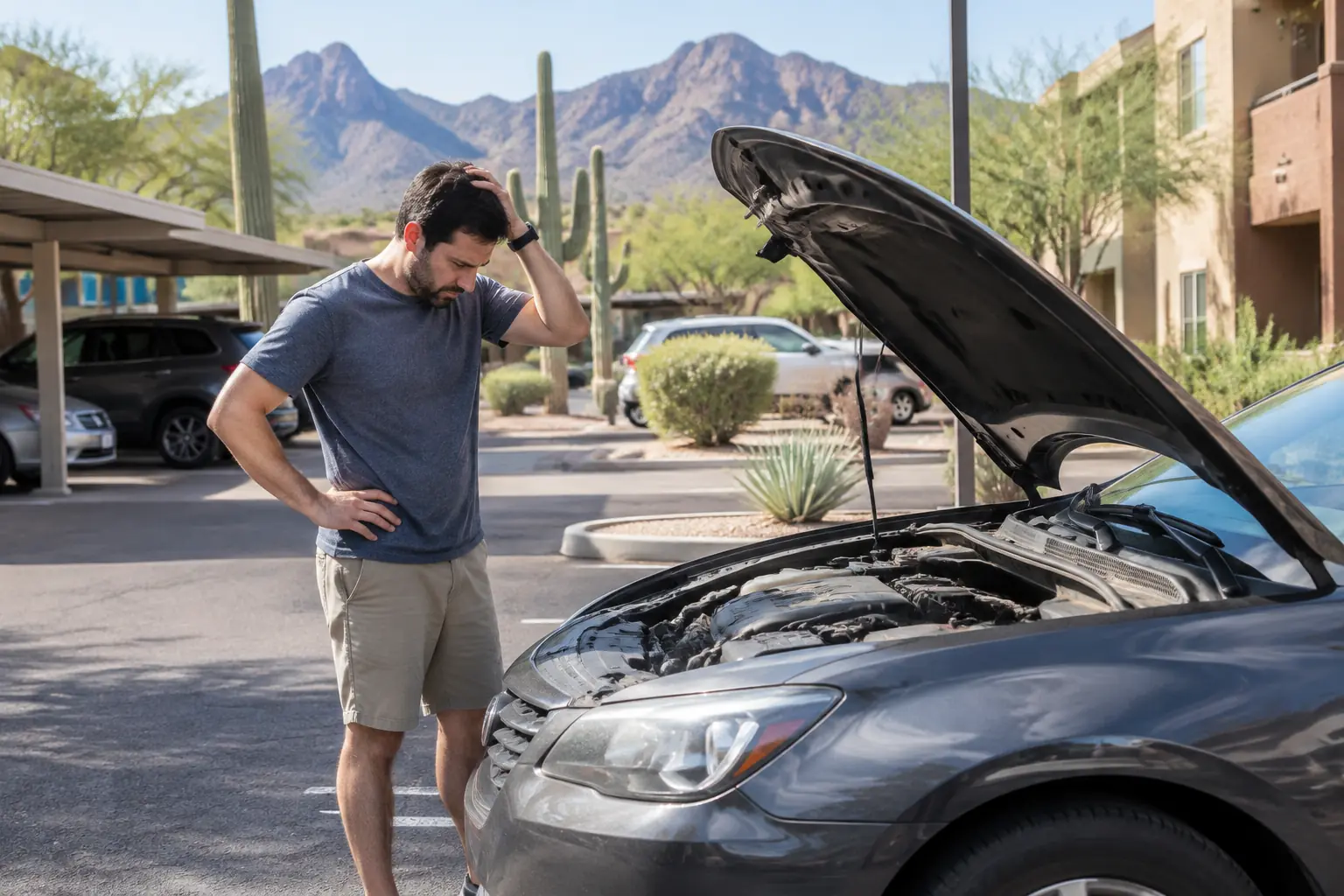
If your car won't start in Tucson, first get somewhere safe, then check whether the engine clicks, cranks, or stays silent. The Mando Guild helps Tucson car owners sort out the cause with mobile diagnosis, a written estimate, and approved repairs at your home, workplace, or a safe roadside location.
1. Make your Tucson location safe before troubleshooting
Before opening the hood, look at where the car is stopped. A parking space at home presents different risks from the shoulder of I-10 or a busy stretch of Oracle Road. Set the parking brake and select Park, or Neutral for a manual transmission. Use hazard lights when appropriate to warn approaching traffic. Do not stand in a traffic lane, work beside moving vehicles, or crawl underneath the car.
If you cannot safely reach the hood, skip the checks below. Tell the person you call your location, direction of travel, and whether the vehicle is blocking traffic. Call 911 for immediate danger, fire, or a medical emergency. Our Tucson roadside breakdown guide covers highway safety in more detail.
Heat matters while you wait. Move to a safe, cooler place if one is accessible, and make sure everyone has water. Dizziness, weakness, or confusion during heat exposure warrants prompt attention, with confusion potentially signaling a medical emergency.[1] Do not let a troubleshooting checklist distract you from someone who is becoming ill.
2. Listen to one brief starting attempt
Turn off the radio and climate fan so you can hear what happens. Make one brief starting attempt, following your owner's manual. Cranking means the starter is turning the engine, usually with a rhythmic turning sound. An engine that cranks but never runs belongs on a different diagnostic path from one that does not turn at all.
Rapid clicking, one solid click, silence, and slow cranking are useful observations, but none identifies a failed part by itself. A weak battery or poor electrical connection can interrupt starter operation, while a starter or its control circuit can also prevent cranking. Battery, starting, and charging checks help separate those possibilities.[2]
Record the sound on your phone if you can do so safely. Note whether the dashboard stays lit, goes dark, or displays a message during the attempt. Avoid repeatedly holding the key or pressing Start to see if something changes. If you hear grinding, notice smoke, or smell burning, stop trying. For a closer look at clicking alone, see how clicking can point toward the battery or starter.
3. Use the lights test as a clue, not a verdict
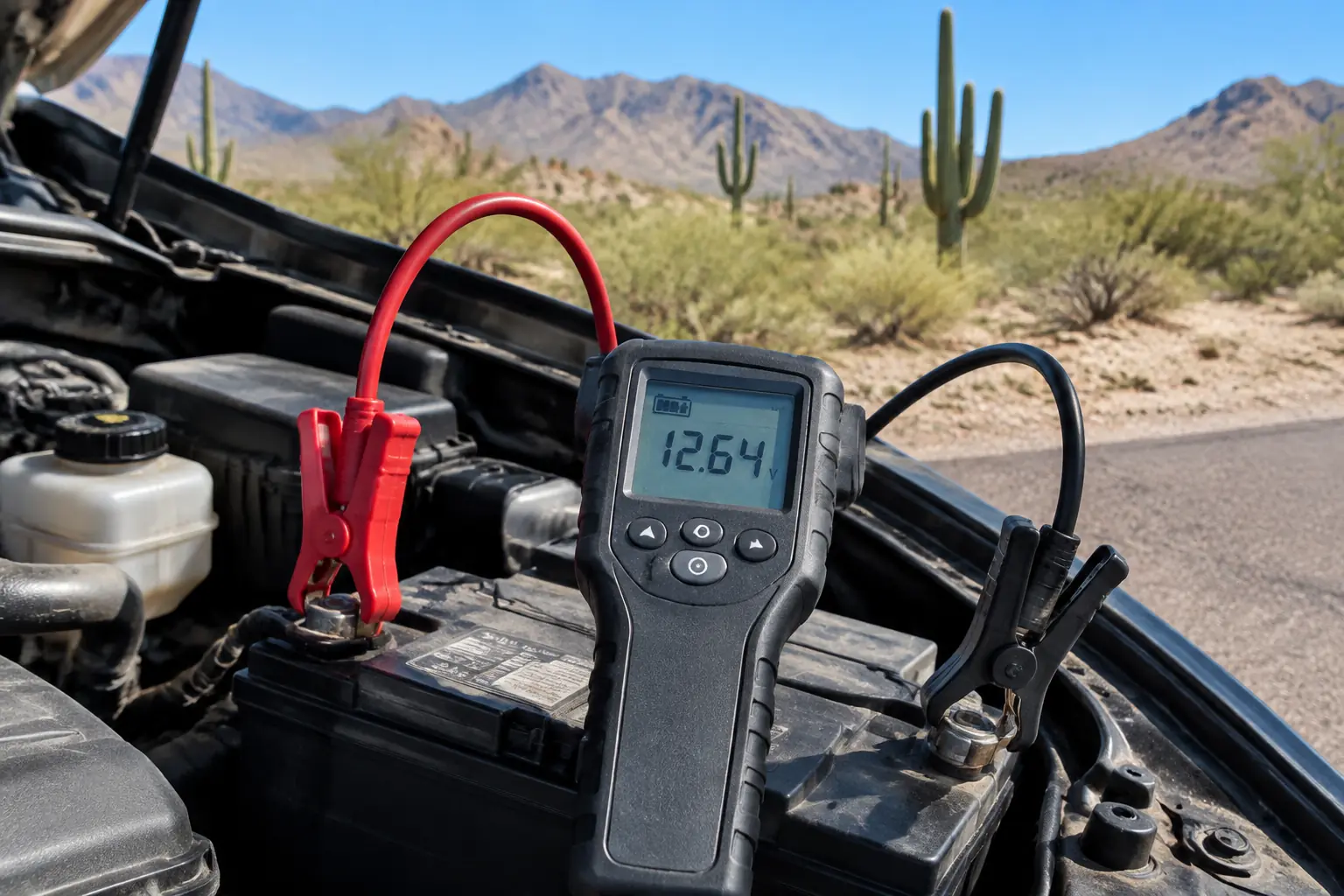
With the engine off, switch on the headlights briefly and look at the dashboard. Completely dark lights can suggest a discharged battery or an interruption in the main electrical supply. Lights that are already weak, then become much dimmer during a starting attempt, make available battery power and cable connections worth checking. A battery test is more useful than appearance alone when deciding whether replacement is needed.[3]
Bright headlights do not prove that the battery can operate the starter. Starting places a different demand on the electrical system than lighting does. Likewise, some vehicles intentionally switch off accessories during starting, so a radio that goes silent is not a diagnosis. Watch the overall pattern rather than treating one light or accessory as a pass-or-fail test.
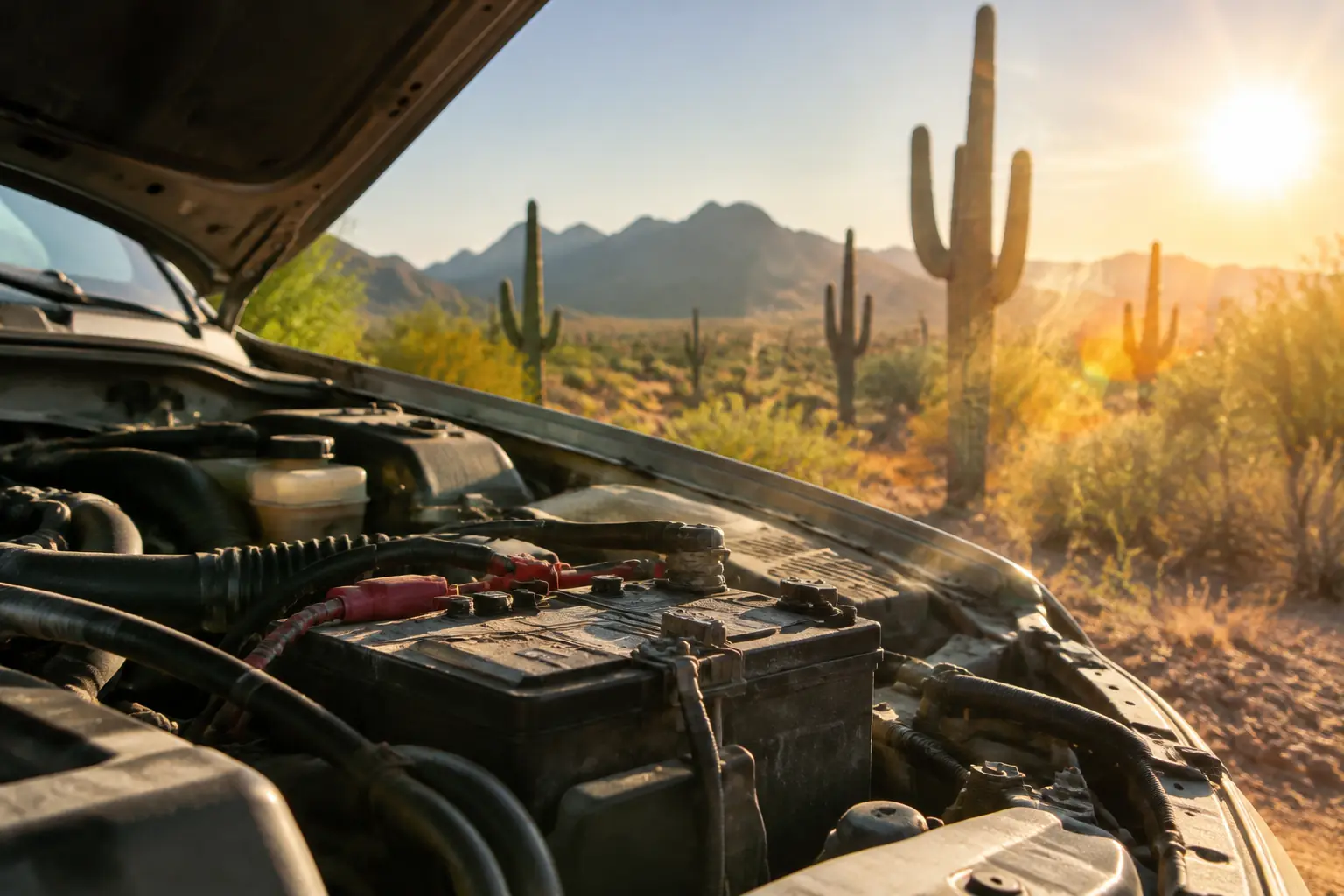
Turn the headlights back off after checking. If the battery is safely accessible, look without touching for a displaced cable, heavy buildup, swelling, or leakage. Do not wiggle terminals with a metal tool or bridge them to test for power. Battery care includes checking connections and condition, but damaged batteries require caution rather than improvised roadside work.[4]
4. Check the starting conditions before blaming a part
Confirm that an automatic transmission is fully in Park and that you are pressing the brake as required. With a manual transmission, fully depress the clutch and make sure a floor mat is not obstructing pedal travel. Starting interlocks are there to prevent unintended movement. Do not bypass one or try to start the vehicle by connecting wires.
If your owner's manual permits starting in Neutral, you can try it with the parking brake set and your foot firmly on the brake. Make this check only where the car cannot roll into traffic or another vehicle. If it starts in Neutral but not Park, tell the mechanic exactly that. It is a useful observation, not permission to ignore a developing problem.
Read any message on the instrument panel before switching everything off. A message about the brake pedal, gear position, steering lock, or missing key can narrow the next step. Check that you have the correct key, especially if several similar keys are nearby. Keep these checks brief so you do not drain the battery while searching menus or repeatedly cycling the ignition.
5. Decide whether a jump start is appropriate
A jump may be reasonable when the engine turns slowly, rapid clicks accompany dim lights, or accessories were left on. It is less useful when the engine already cranks at its usual speed. Read the vehicle's jump-start instructions first, including the location of designated terminals. If you cannot identify the terminals or verify the required voltage, stop and request help.
Do not jump a battery that is cracked, leaking, swollen, unusually hot, or giving off a strong sulfur-like odor. Keep cigarettes, flames, and sparks away, remove metal jewelry, and use eye protection. Battery condition and safe handling matter because batteries contain hazardous materials and can release explosive gas.[4] Do not lean directly over the battery.
Hybrid and electric vehicles need special care. Their low-voltage system is separate from the high-voltage propulsion battery, and high-voltage components are not a DIY jump-start target.[5] Never touch orange cables or use a hybrid or EV as a donor unless its manual specifically permits it. A portable jump pack also requires the correct settings and its manufacturer's procedure. If either manual prohibits the setup, do not proceed.
6. Follow a safe jump-start sequence
For conventional negative-ground, 12-volt vehicles whose manuals allow jumper cables, park close enough for the cables to reach without letting the vehicles touch. Set both parking brakes, turn both ignitions off, and switch off accessories. Keep cables clear of fans, belts, and other moving parts. Electric cooling fans can operate unexpectedly, so do not reach into their path.
Follow both manuals if their instructions differ from the general sequence below. Some vehicles have remote jump terminals rather than accessible battery posts. Do not guess at a grounding point, and never allow the clamps to touch each other once connected. If you are using a jump pack, follow its instructions instead of adapting the donor-vehicle sequence.
After connecting, follow the manuals for donor operation and attempt duration. If the disabled vehicle starts, disconnect in reverse order, keeping the clamps separated and away from moving parts. If it does not start after a brief permitted attempt, stop and reassess rather than repeating long attempts. Disconnect and stop immediately if cables become hot or you notice smoke.
- Connect the red clamp to the disabled vehicle's designated positive terminal.
- Connect the other red clamp to the donor battery's positive terminal.
- Connect the black clamp to the donor battery's negative terminal.
- Connect the remaining black clamp to the disabled vehicle's designated ground point, away from the battery and fuel system.
7. If it cranks normally, consider fuel and security clues
When the engine turns at its normal speed but never catches, focus on observations instead of another jump. Check the fuel gauge and recall the last fill-up. Mention if the vehicle was parked on a slope or recently ran very low. Fuel delivery, ignition, engine controls, and mechanical condition can all require investigation in a crank-but-no-start complaint.[2]
Do not add fuel based only on a guess, spray starting fluid into the intake, or disconnect a fuel line to see whether fuel arrives. If you smell raw gasoline strongly or see a leak, stop starting attempts and keep ignition sources away. A gauge reading and your recent driving history are useful information for the mechanic, but neither confirms fuel pressure.
Watch for a security indicator or a 'key not detected' message. Some security systems inhibit cranking, while others allow cranking but prevent the engine from running. Try an authorized spare key if available, or follow the manual's backup fob-position procedure. Do not attempt an immobilizer bypass or random reset instructions. Report recent key, alarm, or remote-start work because those details can help guide diagnosis.
8. Account for Tucson heat and monsoon exposure
A no-start after a hot afternoon outside Tucson Mall can feel sudden even when the battery has been weakening. Heat can accelerate battery deterioration, so a battery that worked yesterday still deserves testing today.[4] The immediate task is to identify the symptom, not assume that Tucson weather automatically means you need a replacement. Our guide to Tucson heat and car batteries explains the longer-term issue.
Tell the mechanic if the car starts when cool but refuses after a short stop on Grant Road or Speedway Boulevard. Also mention whether the problem followed rain, a wash, extended parking, or recent repairs. Timing and conditions help us choose checks without asking you to recreate an unsafe situation.
During monsoon weather, never enter flooded pavement to reach or move a disabled car. Floodwater depth and road condition can be difficult to judge, and vehicles can be swept away.[6] If the engine stopped after entering water, do not try to restart it. Describe the exposure and arrange safe recovery and inspection instead. A no-start in that setting needs a different response from an ordinary discharged battery.
9. Treat a successful jump as information, not a repair
If the engine starts with outside power, that tells you the added electrical supply helped. It does not establish why the battery was low or prove that the battery itself is defective. An accessory left on, a poor connection, a charging problem, or an unwanted electrical draw can require different solutions. Testing the battery and charging system helps distinguish those causes.[2]
Watch for a charging warning that remains illuminated after the engine is running. If the car stalls again, runs poorly, smells hot, or shows other serious warnings, stop somewhere safe and request help. Do not assume a drive around the block will restore reliability. Avoid running the engine in a garage or other enclosed space while waiting.
Never disconnect a battery cable with the engine running as an alternator test. Use proper diagnostic equipment instead. If you shut the engine off after a jump, be prepared for it not to restart, and choose a safe place where help can reach you. Tell us whether it continued running after the cables were removed and whether any warning lights stayed on.
10. Get mobile no-start diagnosis in greater Tucson
The Mando Guild brings a stocked service van to your home, workplace, or safe roadside location. We do not have a walk-in shop. When you contact us, share the year, make, model, exact location, starting sound, dashboard messages, and any jump-start result. Tell us about access restrictions or traffic hazards before we head toward the vehicle.
Every job starts with diagnosis and a written estimate. Depending on the symptom, we check battery condition, connections, starting and charging operation, or relevant engine and security-system information. Nothing is replaced until you approve it. We service most makes and models and use OEM-grade parts. Our battery, starter, and alternator service addresses confirmed faults rather than replacing parts based on clicking alone.
We serve greater Tucson, including Flowing Wells, Amphi, Casas Adobes, Catalina Foothills, Oro Valley, Marana, the University of Arizona area, Midtown, Downtown, and South Tucson. Roadside help is available only during business hours, and unsafe locations may require recovery before hands-on diagnosis. Call (520) 704-0441 or request service Monday through Friday, 8 a.m. to 5 p.m.; we are closed Saturday and Sunday.
Sources
- National Weather Service, "Heat Safety." www.weather.gov/safety/heat (opens in a new tab)
- Car Care Council, "Car Care Guide." www.carcare.org/car-care-guide/ (opens in a new tab)
- Consumer Reports, "Car Batteries." www.consumerreports.org/cars/car-batteries/ (opens in a new tab)
- AAA, "Car Battery Maintenance: 9 Expert Tips to Extend Battery Life." www.aaa.com/autorepair/articles/car-battery-maintenance-9-expert-tips-to-extend-battery-life (opens in a new tab)
- U.S. Department of Energy, AFDC, "Maintenance and Safety of Electric Vehicles." afdc.energy.gov/vehicles/electric-maintenance (opens in a new tab)
- National Weather Service, "Turn Around Don't Drown." www.weather.gov/safety/flood-turn-around-dont-drown (opens in a new tab)
FAQ
Quick answers
Keep reading
 Pillar guideCar Battery Dying in Tucson Heat? Your Complete GuideLearn how Tucson heat damages car batteries, when to test yours, and how mobile diagnosis separates battery, starter, and alternator problems.Read more: Car Battery Dying in Tucson Heat? Your Complete Guide →
 9 min readMobile Car Battery Replacement in Tucson, at Your LocationSee how on-site battery replacement works in Tucson, from diagnosis and terminal cleaning to memory settings and recycling.Read more: Mobile Car Battery Replacement in Tucson, at Your Location →