

Batteries & starting · Guide
Mobile Car Battery Replacement in Tucson, at Your Location
9 min readBy The Mando Guild mechanics
Mobile car battery replacement in Tucson is an on-site service for a weak or failed battery that leaves your car unable to start reliably. The Mando Guild brings a stocked service van to your location, diagnoses the problem, and provides a written estimate before you approve any replacement.
What mobile battery service means in Tucson
An on-site battery appointment brings the inspection and replacement process to your parked vehicle. You do not need to arrange a trip to a walk-in shop just to find out why the car will not start. The Mando Guild serves homes, workplaces, and suitable roadside locations across greater Tucson. Our registered hub is in Flowing Wells, but we do not operate a walk-in shop.
The appointment is about resolving the electrical starting problem, not simply delivering a battery. A discharged battery and a battery that can no longer hold useful charge are different conditions. Loose connections or charging-system trouble can also affect starting, so testing belongs ahead of parts replacement. Routine battery care includes checking connections and keeping terminals clean.[1]
This article walks through the actual visit, including power preservation, installation, electronic setup, and the old battery's next destination. For the broader effects of desert conditions, see our guide to Tucson heat and your car battery. Here, the focus stays on what you should expect while the vehicle is being serviced and what questions to ask before approving the work.
Preparing a safe work area in Flowing Wells or Midtown
When you request service, share the year, make, model, engine information if known, and your exact location. Describe what happens when you try to start the car and mention any recent jump start or battery replacement. A vehicle identification number can help clarify the application. Battery size, terminal arrangement, and performance specifications vary, so matching the vehicle matters more than matching appearance.[2]
A level driveway or authorized parking space with room around the vehicle makes assessment easier. Tell us about garage clearance, parking restrictions, locked gates, or a battery located beneath a seat or in the cargo area. You do not need to uncover the battery yourself. Keep the key available, remove personal belongings from the access area, and arrange permission if the vehicle is on someone else's property.
A roadside location needs a separate safety assessment. Being able to reach the car does not automatically make the shoulder a suitable work area. If traffic exposure or vehicle position makes service unsafe, moving the vehicle through an appropriate recovery service may be necessary. Roadside help from The Mando Guild is available only during business hours, not overnight or on weekends.
Diagnosis and your written estimate come first
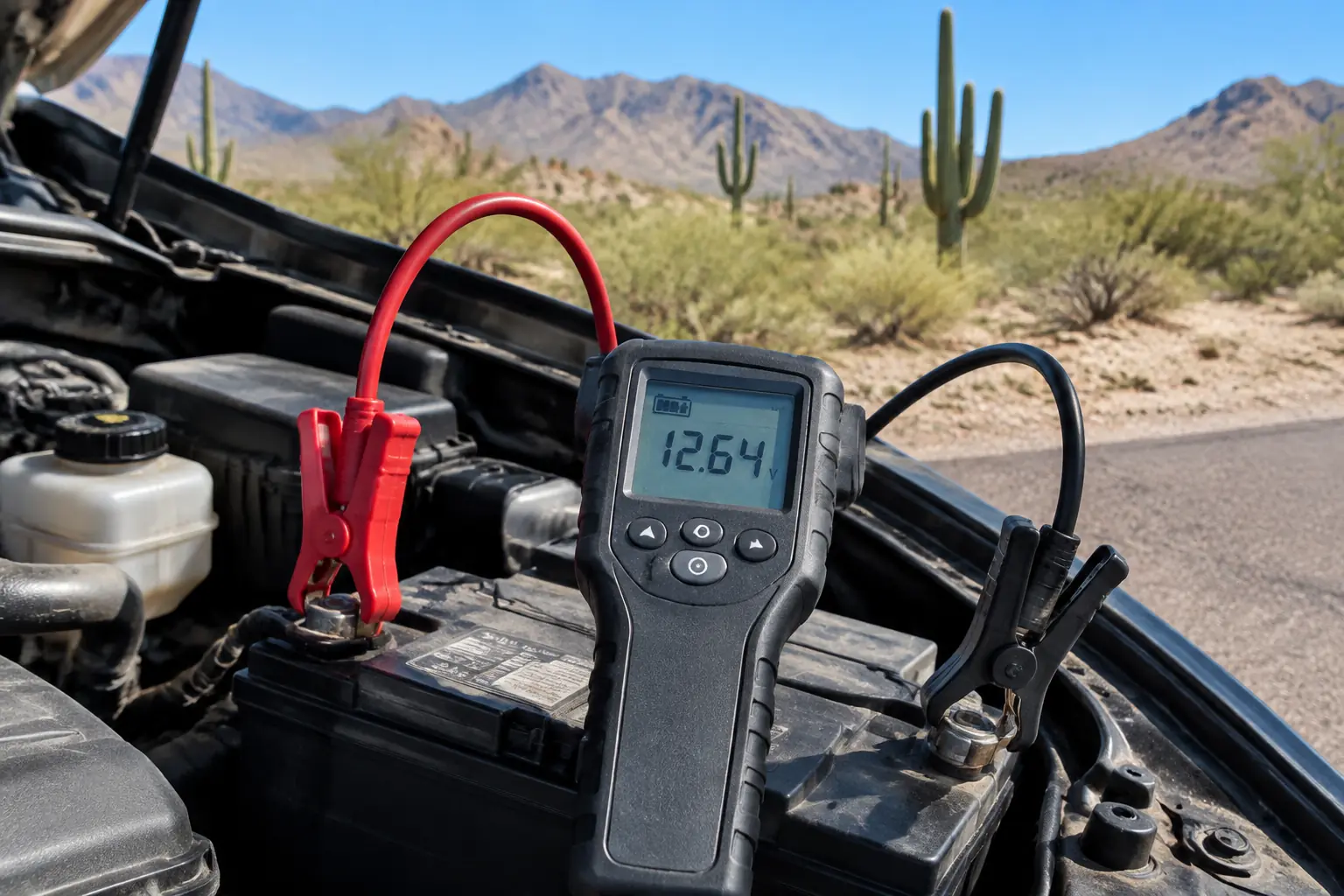
Every job starts with diagnosis. For a starting complaint, the assessment considers battery condition, terminal connections, visible cable damage, and the symptoms you report. Testing has to account for the battery's state of charge. A deeply discharged battery may need charging and retesting before its condition can be judged fairly, rather than being condemned from a single voltage reading.[3]
The checks also help establish whether a replacement battery would address the complaint. Depending on what the vehicle does, the starting or charging system may need further evaluation. If a battery repeatedly goes flat while parked, finding the cause may require a separate electrical diagnosis. Our guide to a car that will not start covers the wider range of possible causes.
We explain the findings and provide a written estimate before anything is replaced. That discussion should identify the proposed battery, access requirements, connection repairs if needed, and any vehicle-specific electronic setup. The Mando Guild uses OEM-grade parts and services most makes and models. You approve the work before replacement begins, and an unexpected finding should prompt a conversation rather than an unapproved addition.
Confirming the battery before disconnecting power
The replacement needs to fit the tray, connect without straining cables, and meet the vehicle's specified battery requirements. The hold-down and any vent connection must also match the application. Some vehicles require an absorbed glass mat battery, commonly called AGM, or another specified design. Choosing only by a familiar brand or a larger advertised starting rating can miss those requirements.[2]
Before removal, the technician checks the installed battery against the vehicle requirements rather than assuming the previous installation was correct. This matters when a car has changed owners or already has an aftermarket battery. A battery that physically fits can still be the wrong type. Start-stop equipment, battery monitoring, and the location of the battery all influence what belongs in the vehicle.
This is also the point to identify unusual access needs and inspect the old battery for visible damage. A swollen case, leakage, or damaged connection changes how the work should proceed. Avoid handling a suspect battery or trying to force its cables loose while waiting. Lead-acid batteries contain corrosive electrolyte and require careful handling, even when they no longer have enough power to start the engine.[4]
Deciding when a memory saver is appropriate
A memory saver supplies limited external power while the main battery is disconnected. Depending on the vehicle, preserving power may help retain clock settings, audio presets, and certain learned values. It is not a second starting battery, and it does not guarantee that every setting will survive. The correct approach depends on the manufacturer's service procedure and the condition of the electrical system.
Using one is not automatically the safer or more professional choice. External power can leave circuits energized during work that calls for electrical isolation. Before connecting a support device, the technician needs to determine whether the procedure permits it and whether the designated connection is suitable. If the battery or wiring is damaged, preserving convenience settings takes a back seat to safely isolating the fault.
Tell us before the appointment if your audio system needs a security code or if the car has aftermarket electrical accessories. Keep any available owner documentation handy. If power must be disconnected completely, the handoff should explain which settings need attention afterward. Memory preservation and battery registration are different tasks: keeping the radio clock running does not tell a battery-management system that a new battery has been installed.
Removing the old battery and cleaning the connections
Once the work is approved and the vehicle is prepared, removal follows its service procedure. That includes allowing applicable systems to shut down and disconnecting connections in the specified sequence. On conventional negative-ground vehicles, the negative cable is generally disconnected first and reconnected last. This reduces the opportunity for a tool touching the positive terminal to create a short through nearby grounded metal.
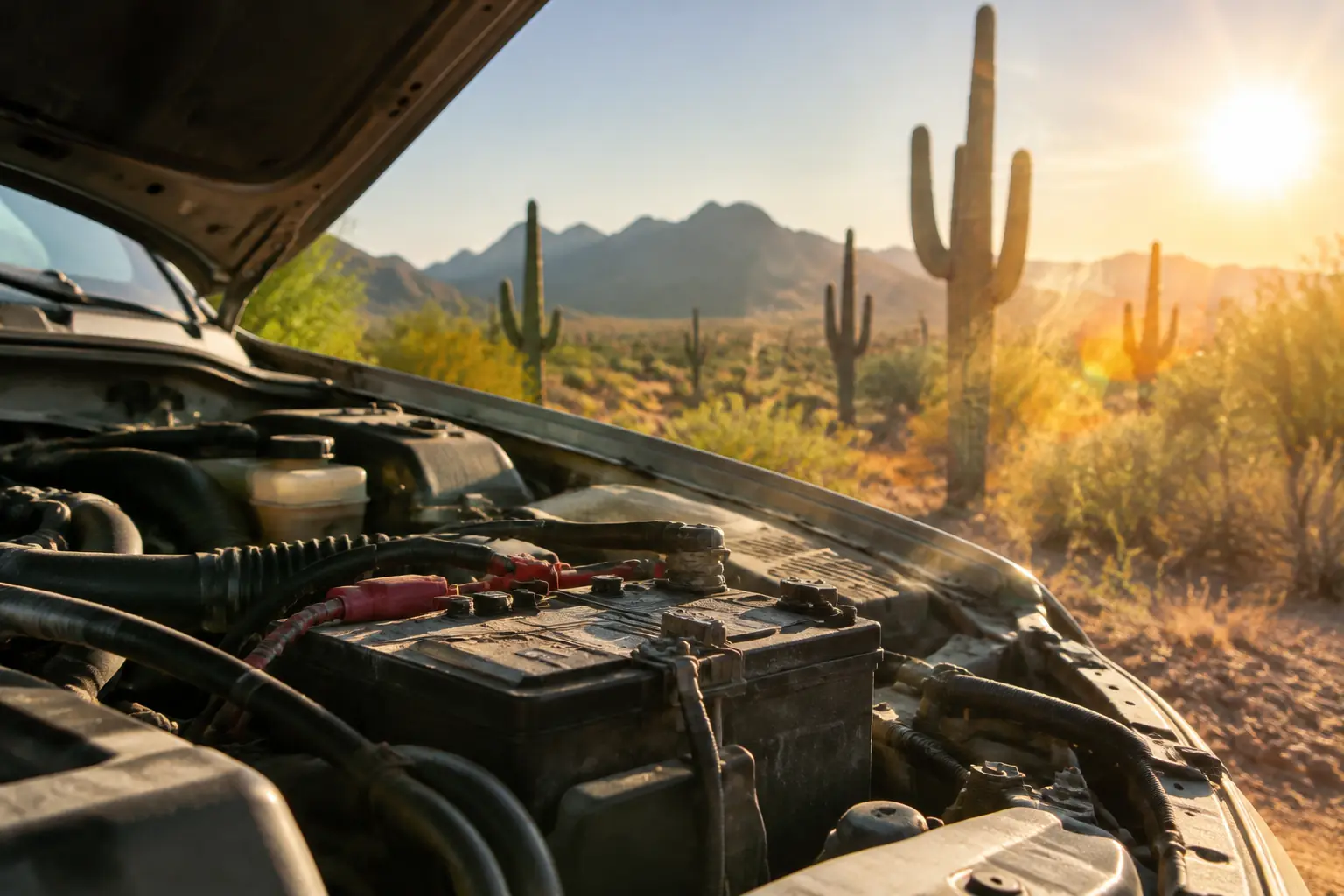
With the battery out, the technician can inspect the tray, hold-down, terminal clamps, and accessible cable ends. Cleaning removes corrosion from the mating surfaces so the new battery is not connected through a layer of residue. Clean, secure connections are part of sound battery maintenance.[1] The work should also keep residue away from nearby components and leave the battery mounting area suitable for installation.
Cleaning cannot restore a cracked clamp, a badly deteriorated cable, or missing mounting hardware. Those findings need explanation and, when repair is required, your approval. For more on what deposits mean, read our guide to battery terminal corrosion. During replacement, the practical goal is narrower: establish sound connections and secure mounting without overlooking damage that could compromise the new installation.
Installing the battery and checking electronic requirements
The new battery is positioned securely, the hold-down is fitted, and any required vent tube is connected. Cable routing should leave connections free of strain and preserve the operation of any battery sensor. Terminal and mounting fasteners need the specified tightening procedure. Excessive force is not a substitute for a proper fit, and a battery should not be able to shift around in its mounting location.
Some newer vehicles require battery registration, a battery-monitor reset, or another manufacturer-defined setup after replacement. Registration informs the vehicle that the battery has been renewed. Depending on the application, changing battery capacity or technology may involve coding as well, if the manufacturer permits that change. Not every newer car requires these steps, and the terms are not interchangeable across all makes.
Ask about these requirements before approving the installation. The procedure and tool compatibility need to be confirmed for your particular vehicle; an ordinary engine-code reader may not provide the necessary function. The estimate discussion should make any equipment or service limitations clear. Where a required setup cannot be completed on-site, you should understand the next step rather than assume that starting successfully means every part of the job is finished.
Verifying operation before the appointment ends
After installation, the technician checks the mounting and connections, confirms starting operation, and evaluates charging behavior as appropriate for the vehicle. Modern charging systems do not all maintain one fixed voltage under every condition, so readings need context. Any warning message that remains deserves explanation. A fresh battery should not be used to dismiss signs that another electrical problem still needs attention.
The handoff is your chance to review what was diagnosed, what was replaced, and what remains unresolved. Ask which settings or relearn procedures apply and whether any follow-up testing is recommended. If an intermittent drain could not be reproduced during the visit, that limitation should be stated plainly. A successful start confirms that the vehicle starts now; it does not prove that every possible parked-current problem has been eliminated.
Mention an upcoming emissions test before the work begins. Disconnecting power can affect emissions readiness on some vehicles, and readiness is distinct from having no warning light. Arizona's myAZcar program explains inspection requirements and readiness issues.[5] Do not assume an immediate drive to the testing station will be appropriate, or that a particular number of miles guarantees the monitors have completed.
Planning around Tucson heat and monsoon weather
During Tucson's hot months, arranging access and a workable parking location helps the visit go more smoothly. Heat can accelerate battery deterioration, but that background does not replace an individual battery test.[6] If shaded parking is available and the car can be moved safely, mention it when scheduling. Do not repeatedly attempt to start a disabled car just to reposition it for convenience.
Summer storms can change an otherwise straightforward driveway or parking-lot appointment. Describe standing water, poor drainage, or access problems when giving directions. Never drive through floodwater to reach a meeting location or try to move a disabled vehicle across a flooded wash. The National Weather Service advises drivers to turn around rather than enter flooded roadways.[7]
The same planning applies near busy routes such as Oracle Road, Grant Road, and I-10. Give a precise location rather than only the nearest major intersection, and explain how the van can safely reach the vehicle. Seasonal conditions may affect where work can proceed. The priority is a safe service location, not keeping an appointment in a spot that has become unsuitable.
Recycling the old battery and arranging service
The old lead-acid battery belongs in an established battery-recycling stream, not a household trash bin. Its lead, plastic, and electrolyte require appropriate recovery and handling. Battery Council International describes the recycling process and the return of recovered materials to battery production.[4] Keeping the battery intact and using a proper collection channel matters more than simply getting it out of the vehicle.
Before authorizing the job, confirm who will take responsibility for the removed battery and whether the replacement involves a supplier core return. Ask for that arrangement to be clear in the estimate. Do not open the case, pour out liquid, or leave the battery where children or pets can reach it. The end of the appointment should leave you with an understood disposal plan, not an unexplained hazardous item.
For mobile car battery replacement in Tucson, our battery, starter, and alternator service begins with diagnosis and your approval of a written estimate. We serve greater Tucson, including Flowing Wells, Casas Adobes, Oro Valley, Marana, and surrounding neighborhoods. Have your vehicle details and location ready so we can discuss the work. Call (520) 704-0441 or request service Monday through Friday, 8 a.m. to 5 p.m.
Sources
- AAA, "Car Battery Maintenance: 9 Expert Tips to Extend Battery Life." www.aaa.com/autorepair/articles/car-battery-maintenance-9-expert-tips-to-extend-battery-life (opens in a new tab)
- Consumer Reports, "Car Batteries." www.consumerreports.org/cars/car-batteries/ (opens in a new tab)
- Car Care Council, "Car Care Guide." www.carcare.org/car-care-guide/ (opens in a new tab)
- Battery Council International, "Battery Council International." batterycouncil.org/ (opens in a new tab)
- Arizona Department of Environmental Quality, "myAZcar Vehicle Emissions Program." myazcar.com/ (opens in a new tab)
- AAA Mountain West Group, "How to Prevent Heat Damage to Your Car Battery." mwg.aaa.com/via/car/prevent-heat-damage-car-battery (opens in a new tab)
- National Weather Service, "Turn Around Don't Drown." www.weather.gov/safety/flood-turn-around-dont-drown (opens in a new tab)
- U.S. Department of Energy, AFDC, "Maintenance and Safety of Electric Vehicles." afdc.energy.gov/vehicles/electric-maintenance (opens in a new tab)
FAQ
Quick answers
Keep reading
 Pillar guideCar Battery Dying in Tucson Heat? Your Complete GuideLearn how Tucson heat damages car batteries, when to test yours, and how mobile diagnosis separates battery, starter, and alternator problems.Read more: Car Battery Dying in Tucson Heat? Your Complete Guide →
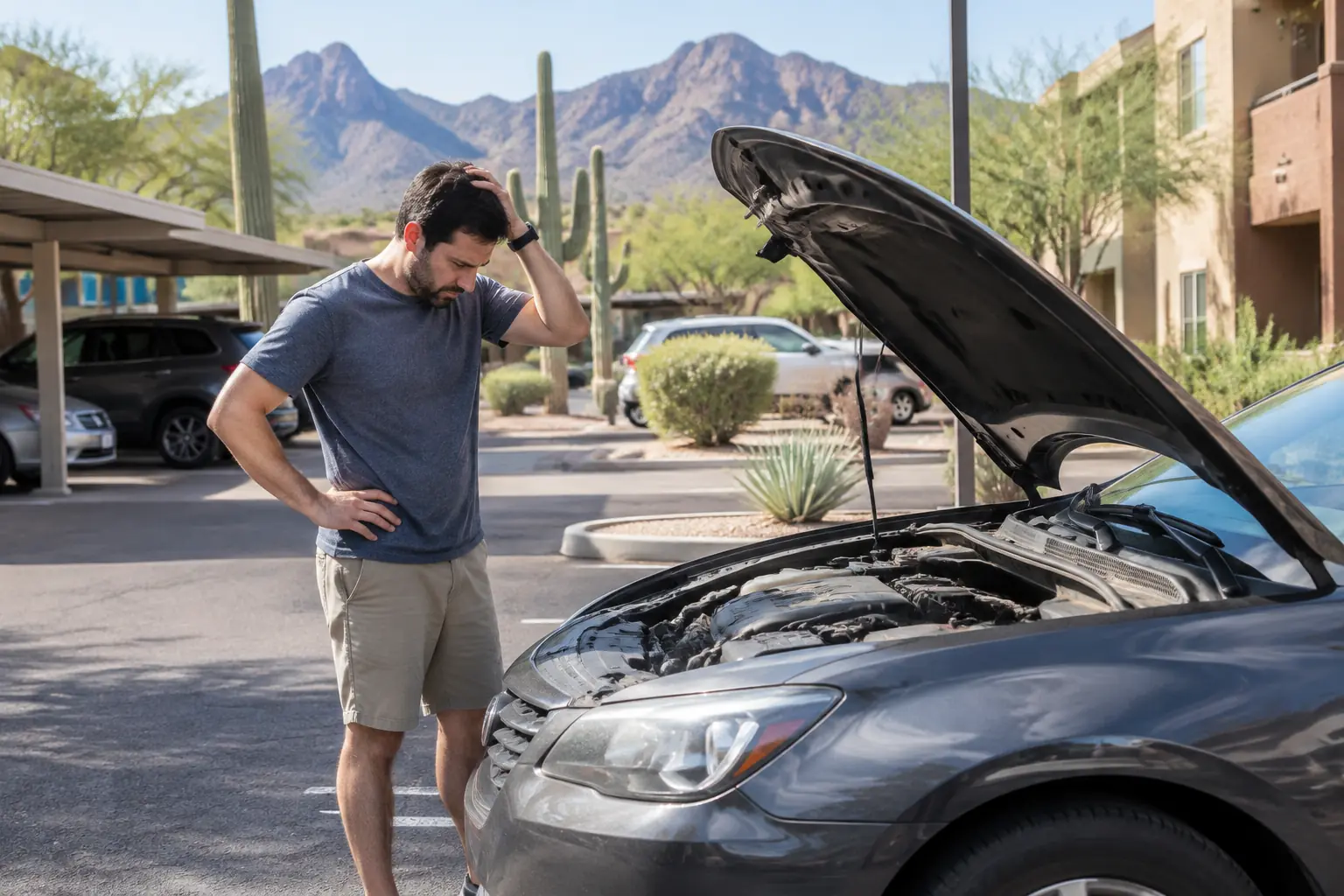 9 min readCar Won't Start in Tucson? What to Do, Step by StepLearn what clicks, cranking, and dashboard lights mean, when a jump is safe, and when to call a Tucson mobile mechanic.Read more: Car Won't Start in Tucson? What to Do, Step by Step →