

Maintenance & oil · Guide
Coolant Service in Tucson: Keeping Engines Out of the Red
9 min readBy The Mando Guild mechanics
Coolant service is maintenance that helps Tucson drivers prevent engine overheating by keeping the right fluid in a sound cooling system. The Mando Guild helps you sort out overdue maintenance, leaks, and cooling concerns with an on-site diagnosis and a written estimate before you approve any work.
What coolant service actually does for your engine
A coolant flush in Tucson should begin with a question: Does your vehicle need scheduled fluid replacement, a repair, or both? Coolant carries engine heat to the radiator and supplies protection against freezing and internal corrosion. Its condition matters even where freezing weather is uncommon. Following the vehicle's maintenance requirements helps protect the cooling system rather than simply making the reservoir look clean.[1]
A drain and refill removes a portion of the old coolant through the vehicle's specified service points. A more extensive exchange replaces more of the remaining fluid, while a cleaning procedure may address certain kinds of contamination. These are not automatically interchangeable services. Ask what the proposed procedure includes, why it fits your vehicle, and how the technician will refill and remove trapped air.
Fresh coolant cannot repair a leaking radiator, restore a failed fan, or make a stuck thermostat operate correctly. A service recommendation should separate fluid maintenance from mechanical problems. That distinction keeps you from paying for a flush when diagnosis should come first. For the broader maintenance picture, use our Tucson mobile maintenance guide alongside your owner's manual and service records.
The parts that keep Tucson engines within temperature
Your cooling system works as a connected circuit. The pump circulates coolant through engine passages, and the thermostat regulates flow as the engine warms. The radiator transfers heat to outside air. Hoses connect the components, while the reservoir accommodates changes in coolant volume. A problem in one part can affect the entire circuit, which is why maintenance should include inspection instead of treating the liquid as an isolated item.[1]
Airflow matters, too. At low road speeds, the cooling fan helps move air through the radiator. Obstructed fins or an airflow problem can limit heat rejection even when the reservoir contains the correct coolant. Looking at the fluid level alone does not establish that the system is healthy. A proper assessment considers temperature behavior, visible condition, circulation concerns, and the vehicle's particular design.
Engine cooling is distinct from air conditioning. The AC system uses refrigerant to cool the cabin; the engine cooling system uses coolant to manage engine temperature. Running AC adds load in hot weather, but a coolant service is not an AC recharge.[2] If the vents blow warm while the engine temperature remains normal, describe that separately when requesting service.
Choose coolant by specification, not by color
The right coolant is the product that meets your vehicle manufacturer's specification. Labels may describe conventional, organic acid, or hybrid organic acid formulations, but those broad categories do not replace the actual approval or specification. Color is not a dependable compatibility guide across brands and vehicles. Use the owner's manual and product documentation rather than assuming that two orange fluids belong together.[3]
This matters when a vehicle's service history is incomplete. A reservoir may contain a mixture left by previous top-offs, and its appearance cannot identify every ingredient. Tell the technician what was added, if you know, and keep the container or a photograph of its label. An unknown mixture calls for evaluation, not another bottle selected because its color seems close.
Premixed coolant already contains water at the labeled ratio, while concentrate requires dilution according to the vehicle and product instructions. Do not dilute a ready-to-use mixture again. When dilution is required, use the specified water quality. More antifreeze is not automatically better protection against Tucson heat. The target is the correct formulation and concentration for your engine, with the system filled and bled as the manufacturer requires.
What coolant strength testing can and cannot tell you
A concentration test helps determine whether the coolant and water mixture falls within the required range. A suitable refractometer can estimate freeze protection from a small sample, provided the instrument and scale match the coolant chemistry. That result is useful in Tucson because mixture strength affects more than cold-weather protection. However, a passing reading does not establish that the coolant still has adequate corrosion protection.
Think of concentration, condition, and service age as separate questions. Fluid can have the expected mixture while being overdue by time or mileage. Conversely, recent coolant may have the wrong concentration after repeated additions of water. The service schedule remains part of the decision even when a sample looks clear. Maintenance records help prevent guessing about fluid age.[4]
Other checks depend on the vehicle and the concern. Compatible test strips may provide additional information, but they are not universal certificates of coolant health. Suspended debris, oily residue, or unusual deposits require investigation. A technician should explain what each test measures and what it leaves unanswered. Ask for the result in plain language, including how it relates to the specified coolant and the recommended work.
Hoses and pressure caps deserve their own inspection
Rubber hoses, connectors, and clamps need attention even when coolant replacement is not yet due. Inspection looks for cracking, swelling, rubbing, leakage, and deterioration near connections. Some hose damage is difficult to judge from the outside, so a clean appearance is not a lifetime guarantee. Regular cooling system checks include hoses and related components, not just the reservoir level.[1]
The pressure cap also has a specific job. Depending on the vehicle, it may be on the radiator or on a pressurized reservoir. It helps the system maintain its designed pressure and manage coolant movement as temperatures change. A replacement must match the vehicle's requirements. Installing a higher-pressure cap is not an appropriate shortcut for a cooling complaint.
Pressure testing can help locate leaks or assess a cap when performed with suitable equipment and the correct limits. It does not prove that every component works under every driving condition. Small leaks may leave dried residue instead of a puddle, while a sweet odor can be a clue to escaping coolant.[5] Report when the smell appears, but never open a hot pressure cap to investigate it.
Plan cooling maintenance before Tucson's summer traffic
When summer highs regularly exceed 100 degrees F, cooling maintenance becomes especially relevant to Tucson driving. The local monsoon season officially runs June 15 through September 30.[6] Those calendar markers are useful reminders to check records and arrange an inspection, but they do not create a universal annual flush requirement. Your vehicle's schedule and condition still determine what is due.
A practical pre-summer check starts with the fully cold coolant level, previous leak concerns, and the date and mileage of the last documented service. Mention repeated topping off, temperature changes, or residue around connections. Allow time to investigate those findings before a busy week of trips along Oracle Rd or a planned highway drive. Preventive scheduling gives you room to make an informed decision.
Do not automatically shorten every fluid interval because you live in the desert. Manufacturer schedules define the conditions that trigger different maintenance requirements, and those definitions vary.[4] Our guide to severe-service schedules in Tucson heat explains that separate question. For coolant, focus on the correct product, documented age, sound components, and any symptoms that suggest maintenance alone will not solve the problem.
If the temperature rises in Oracle Rd traffic
A temperature warning while you are crawling along Oracle Rd is a reason to stop treating the situation as routine maintenance. If the gauge reaches the red zone, a warning directs you to stop, or steam appears, pull over somewhere safe and shut the engine off. Do not keep driving toward home to see whether the temperature settles. Follow the vehicle's warning instructions.[1]
Never remove a radiator or pressurized reservoir cap while the system is hot. Hot coolant and steam can cause serious burns. Do not pour cold liquid into an overheated engine or reach near fans and belts. A fan may start unexpectedly. Wait for professional guidance rather than assuming that a short wait makes the system safe to open.
Switching off AC can reduce engine load while you get safely out of traffic, but it is not a repair or permission to continue driving.[2] Arrange help or towing when needed, particularly if coolant is escaping or the warning returns. Our article on overheating in Tucson stop-and-go traffic covers the diagnostic side in more detail. Once an engine has overheated, the next step is assessment, not an automatic coolant flush.
How The Mando Guild approaches coolant concerns on-site
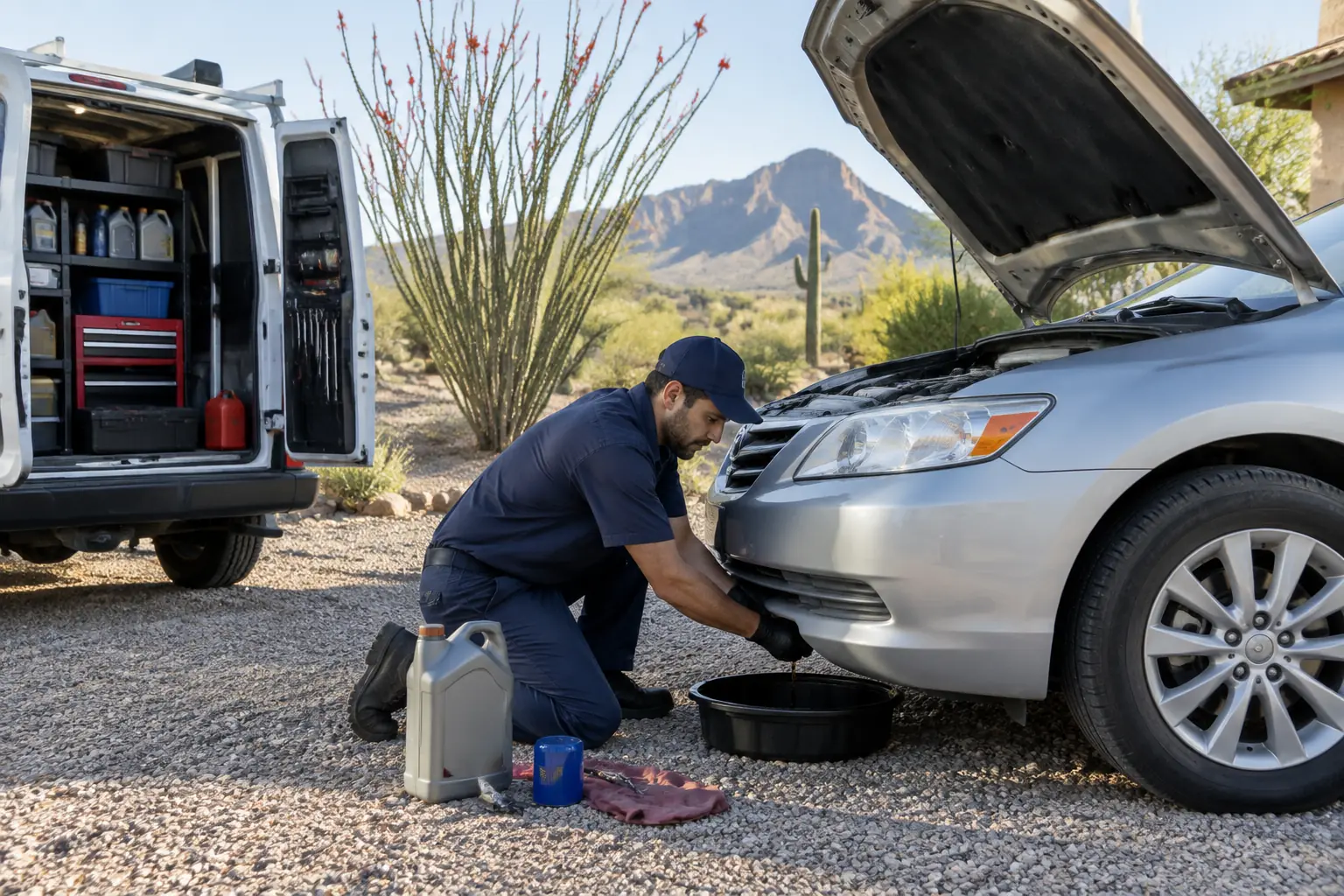
The Mando Guild brings a stocked service van to your home, workplace, or roadside location. We do not operate a walk-in shop. For a coolant concern, the starting point is your vehicle information, service history, symptoms, and a safe place to assess the vehicle. Tell us beforehand if the engine has overheated or is losing coolant so we can discuss the appropriate next step.
Every job starts with diagnosis and a written estimate. For this topic, the assessment considers the specified coolant, cold fluid level, visible leaks, hoses, connections, and cap condition, with further testing guided by the findings and vehicle design. We explain whether the concern points toward maintenance, a component fault, or additional diagnosis. Nothing is replaced until you approve it.
We also discuss whether the proposed work is suitable for the location and what the vehicle requires for a proper refill and air removal. Access, engine temperature, and the scope of the problem matter. The goal is a clear plan, not a promise that every cooling repair can happen in any parking space. Our mobile oil change and maintenance service is a starting point for arranging maintenance and discussing coolant needs.
Check your coolant estimate before approving service
A useful estimate should identify the proposed procedure and the reason for it. Ask whether the recommendation is based on scheduled maintenance, an incorrect mixture, contamination, or a diagnosed leak. Those are different situations. If someone recommends cleaning chemicals, ask why they are needed and whether the procedure is appropriate for your vehicle. The word flush alone does not tell you enough.
Clarify the coolant specification, any proposed parts, and how the system will be checked afterward. Depending on the vehicle, refill procedures may involve particular bleed points, equipment, or operating steps. Trapped air can interfere with proper cooling, so finishing the job means more than pouring fluid into the reservoir. The technician should follow the manufacturer's procedure rather than treating all engines alike.
Keep the final record with the service date, mileage, coolant identification, and completed repairs. Good records make future maintenance decisions easier and help distinguish recurring coolant loss from an isolated service event.[4] If the initial diagnosis reveals another issue, review the updated estimate before authorizing additional work. You should understand what the approved work addresses and which concerns, if any, still require investigation.
Keep a simple coolant watch between Tucson visits
Between appointments, check the reservoir only as directed by your owner's manual, with the engine fully cold and the vehicle parked appropriately. Look at the indicated level without opening a hot system. A photo taken under consistent conditions can help you describe changes later. Keep your hands clear of moving components and leave pressure checks or cap removal to a safe, properly cooled inspection.
Repeated coolant loss deserves diagnosis rather than a routine habit of topping off. Note stains, odors, warning messages, and when they occur. Keep coolant containers away from children and animals, and arrange proper collection of drained fluid rather than letting it reach soil or storm drains. Routine checks and attention to fluid leaks are part of preventive vehicle care.[1]
The Mando Guild serves greater Tucson, including Flowing Wells, Casas Adobes, Oro Valley, Marana, Midtown, and South Tucson. We help you connect maintenance records with what the vehicle is doing now, then provide a written estimate for your approval. Call (520) 704-0441 or request service Monday through Friday, 8 a.m. to 5 p.m. Roadside help is available only during those business hours.
Sources
- Car Care Council, "Car Care Guide." www.carcare.org/car-care-guide/ (opens in a new tab)
- U.S. Department of Energy, FuelEconomy.gov, "Fuel Economy in Hot Weather." www.fueleconomy.gov/feg/hotweather.shtml (opens in a new tab)
- Edmunds, "Car Maintenance." www.edmunds.com/car-maintenance/ (opens in a new tab)
- Consumer Reports, "Your Car Maintenance Checklist." www.consumerreports.org/cars/car-repair-maintenance/your-car-maintenance-checklist-a6808357212/ (opens in a new tab)
- Car Care Council, "Your Nose Knows: Six Vehicle Warning Signs You Can Smell." media.carcare.org/2020-05-18-Your-Nose-Knows-Six-Vehicle-Warning-Signs-You-Can-Smell (opens in a new tab)
- National Weather Service, Tucson, "NWS Tucson Forecast Office." www.weather.gov/twc/ (opens in a new tab)
FAQ
Quick answers
Keep reading
 Pillar guideThe Tucson Driver's Guide to Mobile Oil Changes and MaintenancePlan mobile oil changes and seasonal maintenance around Tucson's heat, dust, and monsoon weather without a trip to a shop.Read more: The Tucson Driver's Guide to Mobile Oil Changes and Maintenance →
 9 min readDoes Tucson Heat Put Your Car on the Severe Service Schedule?Learn how Tucson heat, dust, and short trips affect your car's maintenance schedule and where to find the right intervals.Read more: Does Tucson Heat Put Your Car on the Severe Service Schedule? →
 9 min readChoosing the Right Engine Oil for Tucson Summer HeatLearn how oil chemistry, viscosity, and your engine's specifications guide the right oil choice for Tucson summer driving.Read more: Choosing the Right Engine Oil for Tucson Summer Heat →