

Check engine & diagnostics · Guide
Dashboard Warning Light Colors: What Tucson Drivers Should Do
9 min readBy The Mando Guild mechanics
Dashboard warning lights tell Tucson drivers when to stop, check a problem, or recognize an active vehicle feature. The Mando Guild helps you sort out those signals with mobile diagnosis at your home, workplace, or safe roadside location, followed by a written estimate before you approve any replacement.
Dashboard colors give Tucson drivers a starting point
Red generally asks for immediate attention, amber or yellow usually flags a fault or a condition needing attention, and green or blue commonly identifies an operating feature. These are useful categories, not permission to keep driving. The symbol, accompanying message, and vehicle behavior determine your next move. Your owner's manual is the authority for the exact display in your vehicle. A warning light calls attention to a system; it does not identify the failed part by itself.[1]
For example, a red seat belt reminder and a red oil pressure warning have very different consequences. One asks you to buckle up before moving. The other can require shutting down the engine once you reach a safe stopping place. Likewise, an amber warning accompanied by severe shaking deserves more urgency than its color alone suggests.
If you are searching for dashboard warning lights meaning while sitting in a parking lot, start with three details: the symbol, whether it is steady or flashing, and the message beside it. Photograph the display while parked. Do not use your phone to identify a symbol while traveling on Oracle Road or I-10.
Use this three-level triage guide before continuing
The first level is to stop safely and assess. Treat an oil pressure warning with the engine running, an overheating warning, or a brake warning with abnormal braking as urgent. Reduce speed smoothly and get out of moving traffic without abrupt maneuvers. Once safely stopped, shut down an engine showing an oil pressure or overheating warning. Do not keep it idling while you search for answers. A safe destination nearby is not a reason to operate an engine that may be losing lubrication.
The second level is prompt checking or diagnosis. A steady amber engine light, a tire pressure warning without handling symptoms, or an ABS-only warning may fall here, depending on the owner's manual and vehicle behavior. This category does not mean you can ignore the light until your next scheduled maintenance visit. Check what you can safely check before continuing.
The third level is confirmation rather than repair. A normal turn indicator, high-beam indicator, or enabled-feature symbol may simply report status. Escalate any category if you notice smoke, a strong burning smell, loss of power, unusual steering, or a change in brake response. Symptoms outrank the color chart.
A red oil can asks you to protect the engine
An oil pressure warning generally means the engine may not have adequate oil pressure. It is different from an oil change reminder or an oil level message. Continuing to run an engine with inadequate lubrication can cause serious damage, so this is not a light to watch for several more miles.[1] If it appears with the engine running, move to safety and shut the engine off rather than trying to finish your commute.
Once safely parked on level ground, follow the owner's manual for checking the oil level after the specified wait. Do not reach around hot or moving components. A low dipstick reading is useful information, but a normal reading does not prove that oil pressure is adequate. Oil quantity and oil pressure are related, but they are not interchangeable measurements.
Adding the correct oil, if needed, does not establish why the warning appeared or guarantee that driving is safe. Avoid repeatedly restarting the engine to see whether the light returns. Arrange an assessment and, when safe operation cannot be confirmed, towing. Tell the mechanic whether the light appeared at idle, during a turn, or at road speed.
The battery symbol usually points to charging, not a verdict
On many combustion-engine vehicles, a battery-shaped warning while the engine runs indicates a charging-system problem. It does not automatically mean the battery needs replacement. The charging system includes components and connections that must work together to maintain electrical power.[1] The useful question is whether the vehicle is receiving the electrical supply it needs, not simply how old the battery is.
If that light appears while driving, head only toward an immediately accessible safe stopping place rather than assuming you have a predictable amount of driving time left. Turn off unnecessary electrical accessories, but keep lights, defogging, and other equipment needed for safety operating. If steering suddenly becomes heavy or the temperature warning appears, stop safely and shut down. Multiple symptoms can change the urgency.
A jump start is not proof that the charging system is working. Nor should you disconnect a battery cable with the engine running as a test. Record which warnings appeared first and whether the engine stalled. Our article on alternator failure signs explains the related symptoms without treating the dashboard icon as a parts order.
Amber engine lights need a symptom check
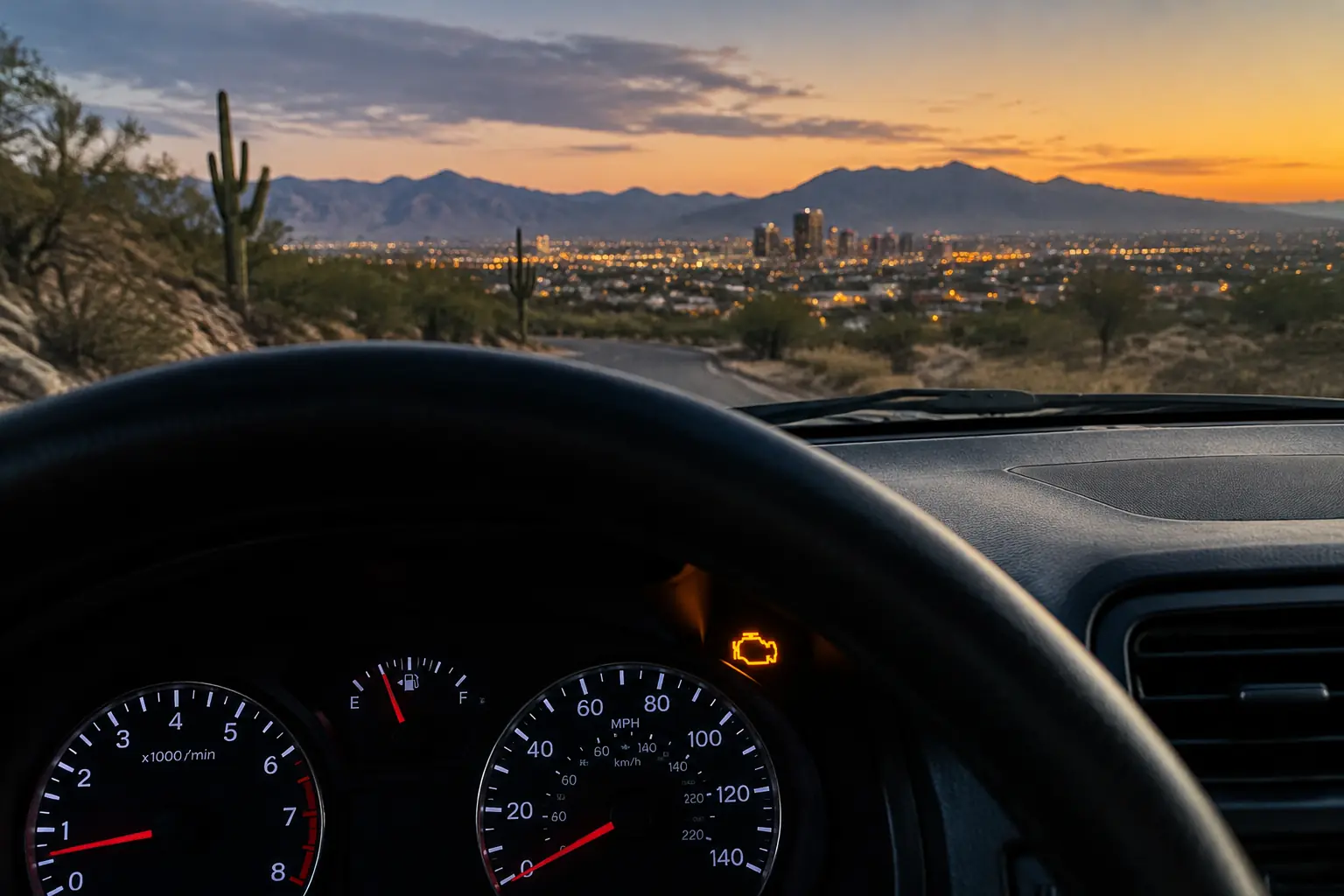
A steady check engine light usually calls for diagnosis, while a flashing check engine light can indicate a misfire severe enough to damage the catalytic converter.[2] That difference makes flashing behavior just as important as color. Do not group a flashing amber engine symbol with an ordinary maintenance reminder simply because both displays look yellow.
With a steady light, first look for other warnings and assess how the vehicle behaves. Rough running, substantial power loss, smoke, or an unusual temperature reading changes the decision. If the vehicle seems normal, consult the manual and arrange diagnosis promptly rather than assuming continued operation is harmless. For the broader diagnostic process, use our Tucson check engine light guide.
If the light flashes, reduce load and pull over safely, especially if the engine shakes or loses power. Do not accelerate hard to test it or repeatedly restart it to reproduce the symptom. Our flashing check engine light guide covers the immediate response. This article's key distinction is simple: an amber light can still ask you to stop.
TPMS warnings ask for a pressure check before a reset
The tire pressure monitoring system, or TPMS, commonly uses a tire-shaped symbol with an exclamation point. It warns when a tire is significantly underinflated, but it does not replace checking tires with a pressure gauge. Use the vehicle's tire information placard or owner's manual for the recommended cold pressure, not the maximum pressure molded into the tire sidewall.[3]
If the light comes on, reach a safe place and inspect the tires before continuing. A visibly low tire, vibration, pulling, or thumping means you should not treat the situation as a simple dashboard reset. Do not drive farther just to find a preferred air pump when a tire appears damaged or cannot support the vehicle properly.
A TPMS light that flashes before staying on can indicate a system malfunction rather than simply low pressure.[3] That does not establish that the tires themselves are properly inflated. Check them manually. Do not bleed air from a hot tire merely to match a cold-pressure specification, and do not reset the system as a substitute for finding the reason for the warning.
Separate an ABS warning from a red brake warning
An amber ABS warning concerns the antilock braking system. Conventional braking may remain available, but antilock assistance may not work as intended. A red brake warning can indicate a parking brake that is still applied or a brake-system concern requiring immediate attention. Brake warning lights deserve prompt investigation rather than an assumption that the vehicle will stop normally.[4]
While safely parked, confirm that the parking brake is fully released. If the red light remains on, consult the manual before moving again. A soft pedal, sinking pedal, fluid leak, or noticeably reduced braking means you should not continue driving. Do not perform a hard-stop test in traffic to decide whether the warning is serious.
When ABS and red brake warnings appear together, take the more conservative approach and arrange assessment before further driving. The combination can mean more than a loss of antilock assistance. Our ABS warning light guide addresses that system in more detail. For immediate triage, the distinction is between a warning about assistance and any sign that basic braking may be compromised.
Green, blue, and driver-assistance symbols need context
Green and blue indicators often show that a feature is operating, such as exterior lighting or high beams. Still, confirm the symbol rather than relying on color alone. Some vehicles also use a blue coolant indicator during warm-up. A green cruise-control symbol may describe a system's status, but the precise distinction between available, enabled, and actively controlling speed varies by vehicle.
Advanced driver-assistance systems, or ADAS, can display warnings for lane assistance, forward-collision alerts, or other functions. A message saying a feature is unavailable means you should not rely on that feature. Driver-assistance technology does not replace an attentive driver who remains responsible for steering, braking, and monitoring the road.[5] Read the words beside the icon before drawing conclusions about what support remains available.
When safely parked, check the manual for permitted cleaning of a camera viewing area or sensor surface. Do not adjust sensor mounts or assume that wiping away dirt has corrected a persistent fault. A collision alert demanding immediate driver attention is different from a service warning about an unavailable system. Respond to the traffic situation first and investigate the display afterward.
Tucson heat and monsoon weather change where you assess a warning
Tucson summer highs regularly exceed 100 degrees F, and the official monsoon season runs June 15 through September 30.[6] Those conditions make your stopping location part of the decision. An exposed shoulder on I-10 is not the place to conduct a lengthy dashboard investigation. Prioritize reaching safety without extending operation when a warning requires an immediate shutdown.
Before leaving a workplace near Speedway Boulevard or a driveway in Flowing Wells, take a moment to read any persistent message. It is easier to arrange an assessment while parked than after entering fast traffic. Heat does not make a warning normal, and a light that disappears after cooling down still deserves documentation if it recurs.
After dusty or rainy driving, a driver-assistance message may mention blocked visibility or an unavailable feature. Follow the vehicle's instructions rather than guessing that the weather explains every warning. If you cannot safely identify the symbol, send a parked photo when requesting service. Include the weather conditions as context, not as your diagnosis, and avoid standing beside traffic to inspect the vehicle.
How The Mando Guild checks warning lights on-site
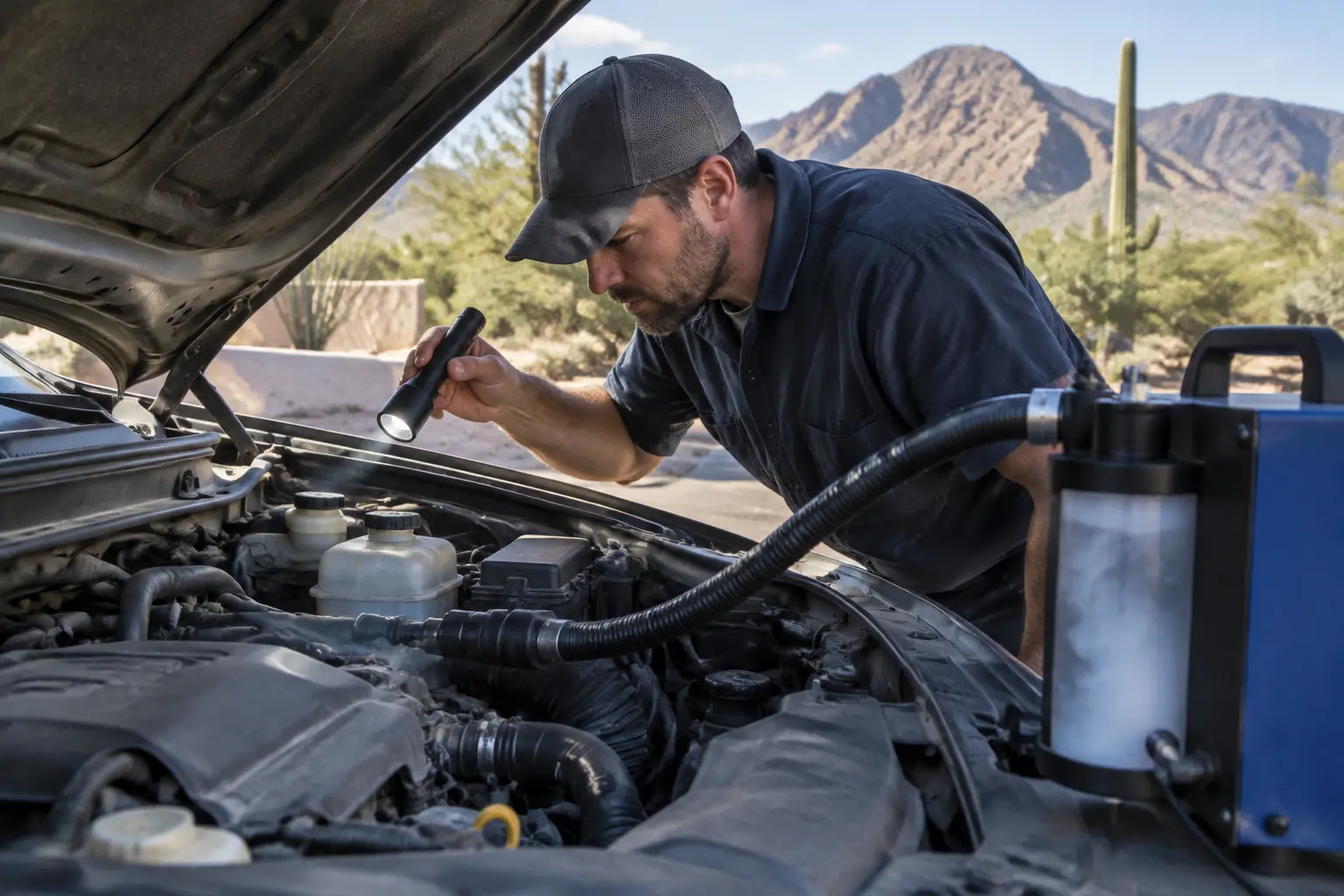
The Mando Guild brings a stocked service van to your home, workplace, or safe roadside location in greater Tucson. We do not have a walk-in shop. For a warning-light concern, the process starts with identifying the exact symbol, reviewing when it appeared, and checking the accompanying symptoms. Tell us about recent maintenance, jump starts, tire work, or battery disconnections so those events become part of the diagnostic history.
Depending on the warning and vehicle, checks may include fluid levels, visible leaks, tire pressures, battery and charging-system tests, or accessible fault information. A basic engine-code scan does not necessarily cover ABS, airbags, or driver-assistance systems. We explain the next appropriate diagnostic step rather than promising that every icon can be resolved with a scanner or an on-site replacement.
Every job starts with a diagnosis and a written estimate, and nothing is replaced until you approve it. Our mobile diagnostics service helps you understand what needs attention and whether further operation is appropriate. If the vehicle should remain parked, do not drive it to meet us. Call (520) 704-0441 or request service Monday through Friday, 8 a.m. to 5 p.m.; roadside help is available only during those hours.
Sources
- Car Care Council, "Car Care Guide." www.carcare.org/car-care-guide/ (opens in a new tab)
- Car Care Council, "Don't Let the Check Engine Light Turn You Off From Making Needed Repairs." media.carcare.org/2018-05-01-Dont-Let-the-Check-Engine-Light-Turn-You-Off-From-Making-Needed-Repairs (opens in a new tab)
- National Highway Traffic Safety Administration, "Tires." www.nhtsa.gov/equipment/tires (opens in a new tab)
- Car Care Council, "Stop and Check Your Brakes." www.carcare.org/2020/08/stop-and-check-your-brakes/ (opens in a new tab)
- National Highway Traffic Safety Administration, "Driver Assistance Technologies." www.nhtsa.gov/vehicle-safety/driver-assistance-technologies (opens in a new tab)
- National Weather Service, Tucson, "NWS Tucson Forecast Office." www.weather.gov/twc/ (opens in a new tab)
FAQ
Quick answers
Keep reading
 Pillar guideCheck Engine Light in Tucson: What It Means and What to DoUnderstand solid and flashing check engine lights, Tucson driving conditions, emissions testing, and mobile diagnosis at your location.Read more: Check Engine Light in Tucson: What It Means and What to Do →
 9 min readFlashing Check Engine Light in Tucson: Your Next Five MinutesLearn when to stop, how to protect your catalytic converter, and who to call when your check engine light flashes in Tucson.Read more: Flashing Check Engine Light in Tucson: Your Next Five Minutes →
 9 min readOBD-II Trouble Codes Explained for Tucson DriversLearn what OBD-II codes tell Tucson drivers, what freeze-frame data adds, and why a scan alone cannot identify the repair.Read more: OBD-II Trouble Codes Explained for Tucson Drivers →