
Check engine & diagnostics · Guide
Flashing Check Engine Light in Tucson: Your Next Five Minutes
9 min readBy The Mando Guild mechanics
A flashing check engine light in Tucson is an urgent warning, usually of an engine misfire that can damage your catalytic converter.[1] The Mando Guild helps Tucson car owners address that warning with mobile diagnosis, a written estimate, and approved repairs at a safe home, workplace, or roadside location.
Treat flashing as a stop-driving warning
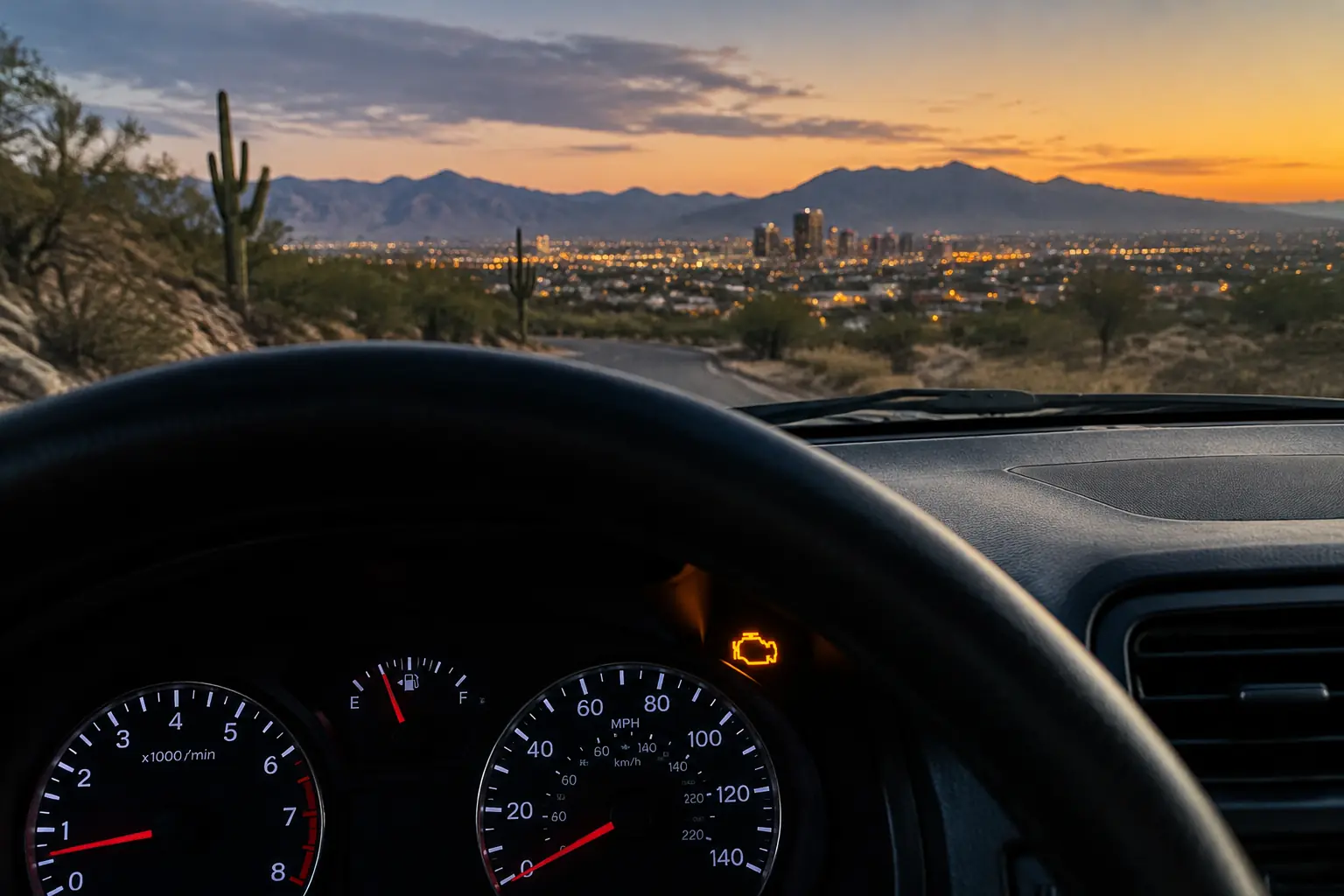
A check engine light that flashes while the engine runs deserves a different response from a steady light. Flashing commonly signals a misfire severe enough to threaten the catalytic converter, so continuing your trip can turn an engine problem into exhaust-system damage.[1] Your immediate task is not to identify the failed part. It is to reduce engine load, reach the nearest safe stopping place, and shut the engine off. Do not interpret this five-minute guide as permission to drive for five more minutes. Stop sooner if you can do so safely.
A misfire means a cylinder is not burning its fuel charge properly. The engine may shake, hesitate, or feel weak, but a lack of dramatic symptoms does not make the warning harmless. Avoid hard acceleration and do not try to maintain freeway speed against a struggling engine. If you also see an oil-pressure warning, a rising temperature gauge, smoke, or rapidly worsening power loss, prioritize getting out of traffic and stopping. For the broader differences between warning patterns, see our Tucson check engine light guide.
Use the first minute to reduce load and find an exit
Ease off the accelerator without braking abruptly. Turn off cruise control, check your mirrors, signal, and look for the closest place that gets the entire vehicle clear of moving traffic. Avoid a sudden lane change simply because the light has started flashing. If the vehicle still responds predictably, use only the power needed to reach that nearby safe spot. Do not accelerate hard to beat a traffic signal or reach a preferred parking lot farther down the road. Safety takes priority over getting the car somewhere convenient for a repair.
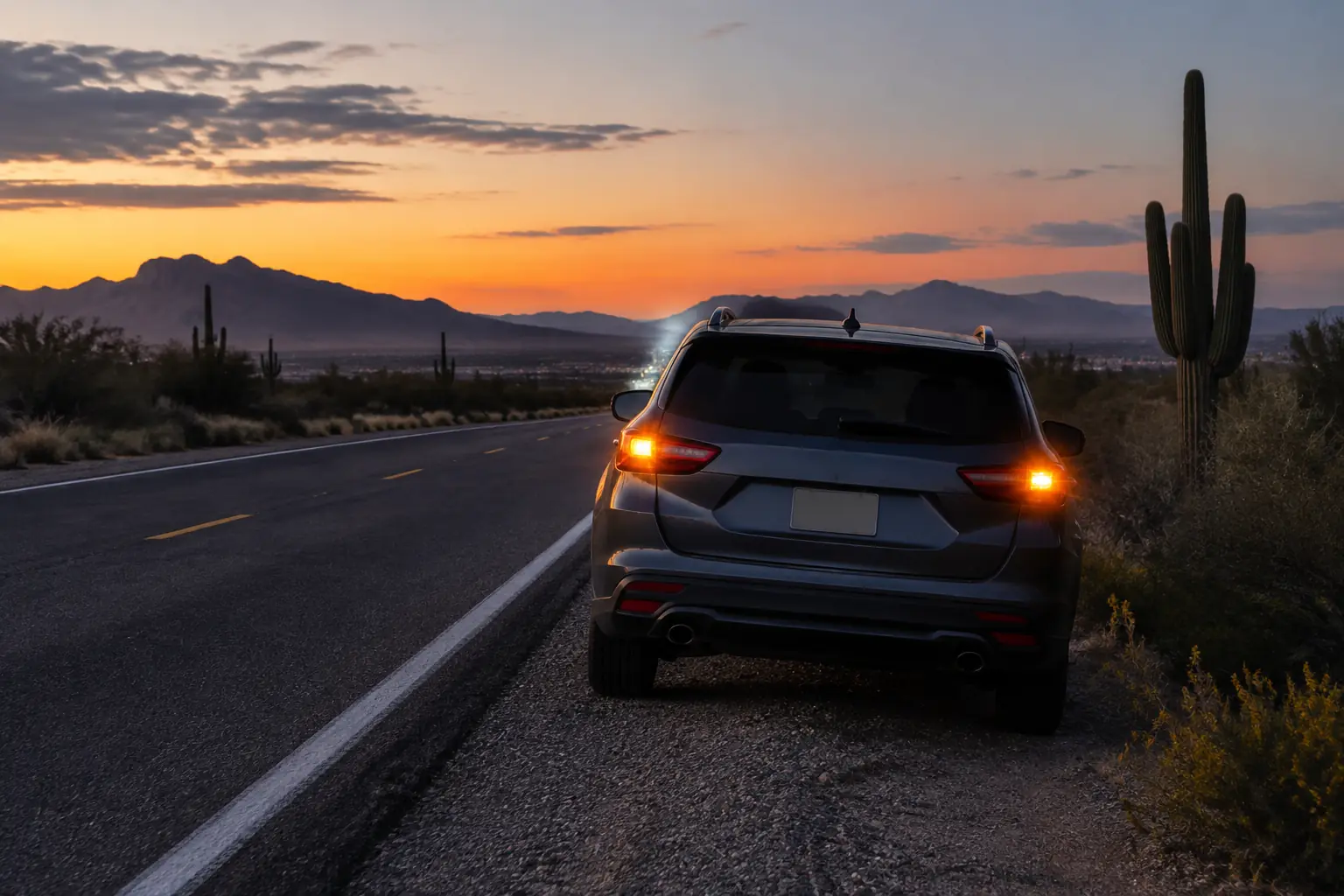
Once stopped, select Park, or secure a manual-transmission vehicle appropriately, set the parking brake, and switch off the engine. In ordinary clear-weather breakdown conditions, use hazard lights to make the stopped vehicle visible. Leave the engine off rather than letting it idle while you search for advice. A misfiring engine can continue sending unburned fuel into the exhaust even when the vehicle is stationary.[1] You do not need to open the hood, scan a code, or call a mechanic before taking this basic protective step.
Choose a safe pull-off on Tucson roads
On Oracle Rd, Grant Rd, or Speedway Blvd, a nearby accessible parking lot may offer more separation from traffic than a narrow curb lane. Use it only if you can enter without crossing traffic unsafely or extending the drive. Do not stop in a turn lane and treat it as a repair space. On I-10, avoid stopping in a travel lane if the car can still reach a shoulder safely. Do not attempt to cross several lanes at once to reach an exit, and do not reverse along the shoulder after passing one.
Your stopping location determines what happens next. A wide, level parking area and a narrow freeway shoulder present very different risks, even with the same engine fault. Do not stand beside the traffic-facing door, walk behind the car into traffic, or attempt an exposed roadside inspection. If you are safely clear of traffic and there is no fire or other immediate threat, remaining belted inside may be safer than standing outside. Call 911 if the vehicle creates an immediate traffic danger. Our I-10 breakdown safety guide covers roadside decisions in more detail.
Understand why the catalytic converter is at risk
The catalytic converter treats exhaust gases; it is not designed to handle an ongoing supply of unburned fuel from a severe misfire. When that fuel reaches the converter, temperatures can climb enough to damage it. That is why a flashing light calls for immediate attention rather than an appointment after several more commutes.[1] There is no dependable number of miles you can drive before damage occurs. Engine load, the nature of the fault, and how long the misfire has already continued all affect the situation.
A flashing light does not prove that the converter is already ruined, and replacing it without addressing the engine fault would miss the source of the problem. The first goal is to stop the damaging operating condition. A proper repair then addresses the cause and checks for remaining symptoms. Fixing a serious engine fault can also restore efficiency lost while the vehicle was malfunctioning.[2] Avoid parking over dry grass or other combustible material, and report smoke or an unusual hot smell rather than crawling underneath to investigate the exhaust.
Spend the next few minutes recording useful details
Once you are safely stopped, note what happened just before the light began flashing. Were you accelerating onto I-10, climbing a grade, waiting at a signal, or traveling at a steady speed? Write down whether the car shook, lost power, made an unusual sound, or showed another warning. Record whether the flashing continued until shutdown or stopped after you eased off the accelerator. These observations help a mechanic understand the conditions surrounding the fault without asking you to reproduce it on the road.
Take a dashboard photo only after stopping, and do not restart the engine just to capture the warning. Have the vehicle's year, make, model, and approximate mileage ready, along with any recent repair information. If someone has already scanned it, save the exact code numbers rather than a summary such as 'bad coil.' Diagnostic codes identify detected conditions, not automatic replacement instructions. Our guide to OBD-II trouble codes explains that distinction. Your location and safety situation matter just as much as the code when arranging help.
Avoid quick fixes that can hide or worsen the problem
Do not rev the engine to clear it out, drive faster to see whether it smooths out, or repeatedly restart it as a test. A temporary improvement is not proof that the underlying fault has disappeared. Do not drive to a parts counter solely for a free scan while the light is flashing. The value of getting a code does not justify exposing the converter to continued misfire. Likewise, tightening the gas cap is not an appropriate response to active flashing accompanied by shaking or power loss.
Leave fault codes stored and avoid disconnecting the battery to extinguish the light. Clearing information can make the next diagnostic visit less informative without repairing anything. Do not unplug ignition components on a running engine or touch hot exhaust parts to judge their temperature. Avoid buying plugs, coils, injectors, or a converter based only on a code description. Misfire diagnosis can involve ignition, fuel delivery, air leaks, and mechanical condition. For that separate diagnostic discussion, see how we approach rough idle and misfires. Right now, preserving the vehicle and keeping people safe come first.
Plan for Tucson heat and monsoon conditions while waiting
During Tucson's hot months, shutting off the engine also means losing normal engine-powered air conditioning. Do not keep a misfiring engine running simply to cool the cabin. Instead, tell the person arranging help if you have children, older adults, pets, or anyone sensitive to heat with you. Never leave a child alone in a parked vehicle, and move to a safe cooled location when one is accessible without crossing dangerous traffic. Heat illness requires prompt attention, especially if someone becomes confused, collapses, or cannot cool down.[3]
During monsoon weather, a tempting pull-off can create another hazard. Do not enter a flooded roadway, wash, or water-covered parking entrance to get out of traffic; water depth and road condition can be difficult to judge.[4] Choose firm ground away from drainage channels where possible. Once parked, you or a passenger can use AZ511 for current highway restrictions and traffic information, rather than relying on an assumed clear route.[5] Tell the mechanic or tow dispatcher about rain, poor visibility, standing water, or limited shoulder space before anyone heads toward your location.
Know when a tow is the safer next step
Arrange towing rather than another drive if the light keeps flashing, the engine shakes severely, power is unreliable, or there are additional serious warnings. Do not restart solely to find out whether those conditions remain. A vehicle that cannot be evaluated safely where it stopped may need relocation before diagnosis, even when a mobile mechanic is available. A roadside visit is not permission to perform repairs beside fast-moving traffic. If there is smoke or suspected fire, get everyone away from the vehicle and traffic when safe, and call 911.
If the flashing stopped before you parked, leave the engine off and discuss the event with a mechanic. A fault can become less noticeable when engine load changes, so a steady light or smooth idle afterward does not establish that continued driving is safe. The Car Care Council recommends prompt attention to a blinking warning because of the potential for severe damage.[1] Outside The Mando Guild's weekday business hours, contact a towing provider or your roadside assistance provider rather than waiting with an unsafe vehicle. Do not assume mobile service includes towing.
What The Mando Guild checks on-site in Tucson
The Mando Guild brings a stocked service van to your home, workplace, or a roadside location where work can be performed safely. We begin by reviewing your symptoms and the circumstances of the flashing warning, then assess the vehicle before deciding what testing is appropriate. That can include retrieving stored and pending codes, reviewing available freeze-frame data, and inspecting accessible wiring, connectors, and ignition components. The point is to gather evidence, not to replace whichever part appears in a scanner's suggested explanation. General car-care guidance supports having warning-light problems diagnosed rather than ignored.[6]
Further checks depend on the vehicle and what the initial findings show. We may need to distinguish an ignition problem from a fuel, air, or mechanical issue before recommending a repair. Testing is controlled, not an invitation to keep a severely misfiring engine running. Every job starts with a diagnosis and a written estimate, and nothing is replaced until you approve it. We work on most makes and models and use OEM-grade parts. Our mobile engine diagnostics service helps establish the next step, including when the location or repair needs make relocation necessary.
Make the call with your location and symptoms ready
When you call, start with your exact location and whether the vehicle is fully clear of traffic. Give the direction of travel, nearest cross street or exit, and a nearby business name if useful. Then explain that the check engine light flashed, describe any shaking or power loss, and say whether the engine is now off. Tell us about passengers who need shelter and any restrictions on accessing the parking area. This lets us discuss the situation without asking you to stand beside the car gathering information in an unsafe place.
The Mando Guild serves greater Tucson, including Flowing Wells, Amphi, Casas Adobes, Catalina Foothills, Oro Valley, Marana, Midtown, Downtown, South Tucson, and the University of Arizona area. Our registered hub is not a walk-in repair shop, so do not drive a flashing-light vehicle there looking for service. Mobile availability and the safety of your location must be discussed before arranging a visit. Roadside help is available only during business hours, and we are closed Saturday and Sunday. Call (520) 704-0441 or request service Monday through Friday, 8 a.m. to 5 p.m.
Sources
- Car Care Council, "Don't Let the Check Engine Light Turn You Off From Making Needed Repairs." media.carcare.org/2018-05-01-Dont-Let-the-Check-Engine-Light-Turn-You-Off-From-Making-Needed-Repairs (opens in a new tab)
- U.S. Department of Energy, FuelEconomy.gov, "Keeping Your Vehicle in Shape." www.fueleconomy.gov/feg/maintain.jsp (opens in a new tab)
- National Weather Service, "Heat Safety." www.weather.gov/safety/heat (opens in a new tab)
- National Weather Service, "Turn Around Don't Drown." www.weather.gov/safety/flood-turn-around-dont-drown (opens in a new tab)
- Arizona Department of Transportation, "AZ511 Traveler Information." www.az511.gov/ (opens in a new tab)
- Car Care Council, "Car Care Guide." www.carcare.org/car-care-guide/ (opens in a new tab)
FAQ
Quick answers
Keep reading
 Pillar guideCheck Engine Light in Tucson: What It Means and What to DoUnderstand solid and flashing check engine lights, Tucson driving conditions, emissions testing, and mobile diagnosis at your location.Read more: Check Engine Light in Tucson: What It Means and What to Do →
 9 min readOBD-II Trouble Codes Explained for Tucson DriversLearn what OBD-II codes tell Tucson drivers, what freeze-frame data adds, and why a scan alone cannot identify the repair.Read more: OBD-II Trouble Codes Explained for Tucson Drivers →
 9 min readLoose Gas Caps and EVAP Warning Lights in Tucson HeatLearn why Tucson heat exposes EVAP problems, what P0455 and P0456 mean, and how testing separates a loose cap from another leak.Read more: Loose Gas Caps and EVAP Warning Lights in Tucson Heat →